
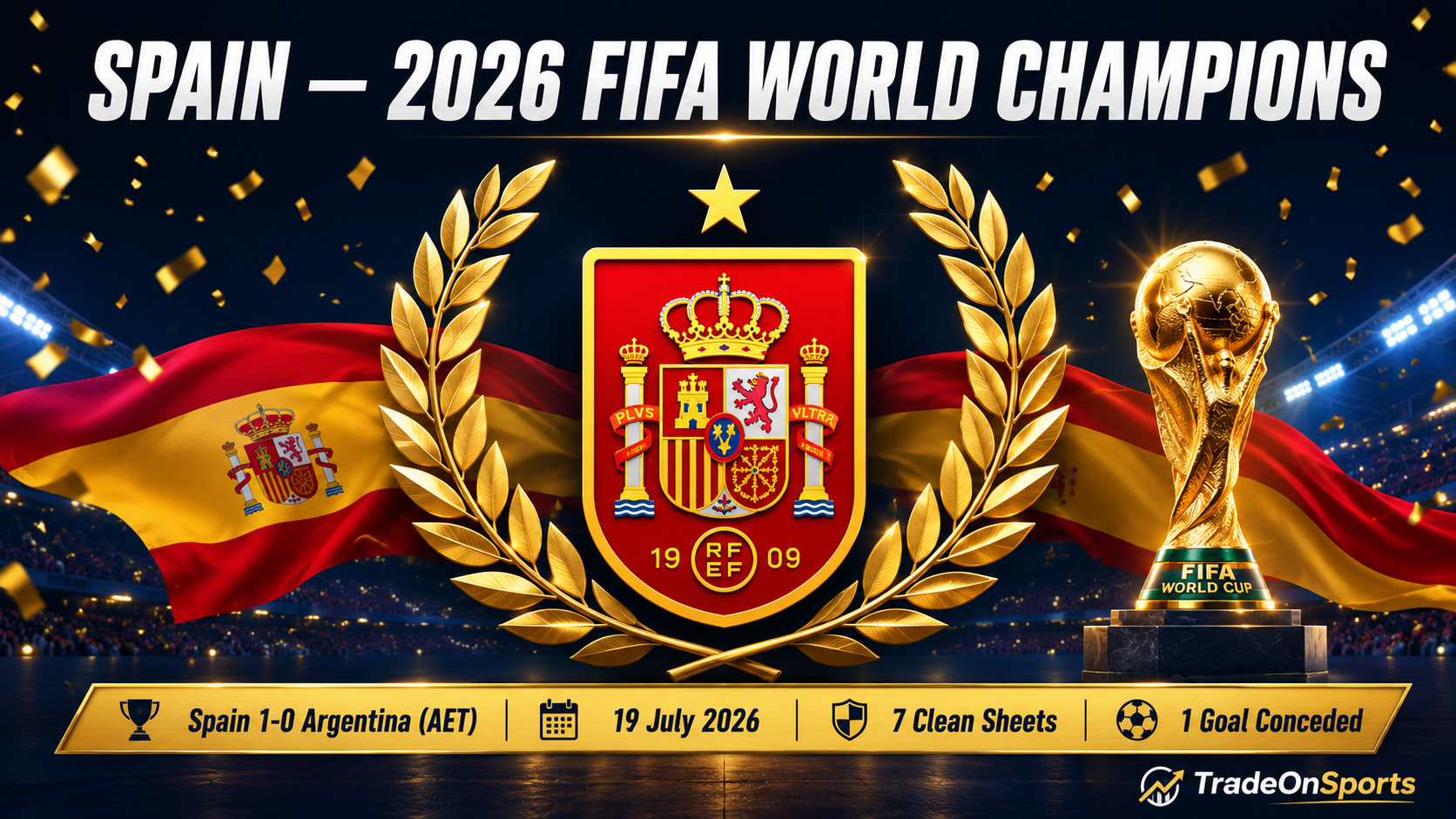
Spain are world champions.
For the second time in their history, Luis de la Fuente’s side have lifted the FIFA World Cup, and they did it in a manner that made the scale of their dominance impossible to argue with. A 1-0 victory over defending champions Argentina after extra time, sealed by substitute Ferran Torres in the 106th minute, brought a tournament that Spain controlled from start to finish to a fitting conclusion.
The numbers tell the story more clearly than words. Spain generated an xG of 1.94 from 20 shots. Argentina managed an xG of 0.2 from just 2 shots, and did not register a single effort on target. It is the first time in the history of the World Cup final that a team has finished the match without a single shot on target. This was not a close game dressed up as one by a scoreline.
How the match unfolded
For 90 minutes, Spain pressed and probed but found Argentina’s goalkeeper in inspired form. Argentina, with their characteristic defensive organisation, held firm through a gruelling first half and a one-way-traffic second half. It looked for long periods as though the statistics might be defied by the final whistle.
The turning point arrived in stoppage time. Enzo Fernández collected a second yellow card for a foul on Pau Cubarsí, leaving Argentina down to ten men at the most critical moment of the match. In the second period of extra time, Spain exploited the space. Ferran Torres, introduced from the bench, rifled the ball into the net in the 106th minute. Spain had their goal. Argentina, with ten men and without a single shot on target in 120 minutes, could not respond.
The record-breaking campaign
This was not just a final victory. Spain’s 2026 World Cup campaign has rewritten the record books.
They conceded just 1 goal in the entire tournament, the fewest by any World Cup-winning team in a single campaign. They kept 7 clean sheets, a record for most in a single World Cup. Luis de la Fuente extended his unbeaten run at major tournaments to 15 games, the longest such record for any manager across the FIFA World Cup and UEFA European Championship combined.
And then there is Lamine Yamal. At 19 years old, he became the first teenager in history to win both the UEFA European Championship and the FIFA World Cup.
What it means
Spain won their first World Cup in 2010 with a generation that redefined the game. This group is different, built on tactical discipline and collective quality rather than a single dominant figure. The statistical profile is striking: 20 shots on target in the final, 11 hitting the target, against a team that managed 2 shots total and none on goal. Argentina, who arrived as defending world champions, were made irrelevant.
For analysts and data-driven observers of the game, this Spain campaign is a case study in defensive organisation. An xGA of approximately 0.2 in a World Cup final, a single goal conceded across seven matches. The numbers suggest this was not fortune. It was a system.
What comes next
The 2026 World Cup is over. For both nations, attention now shifts to domestic preparations and the long cycle of UEFA Nations League and eventual qualification campaigns. For Spain, this summer cements a legacy. For Argentina, a rebuild begins.





No comment