
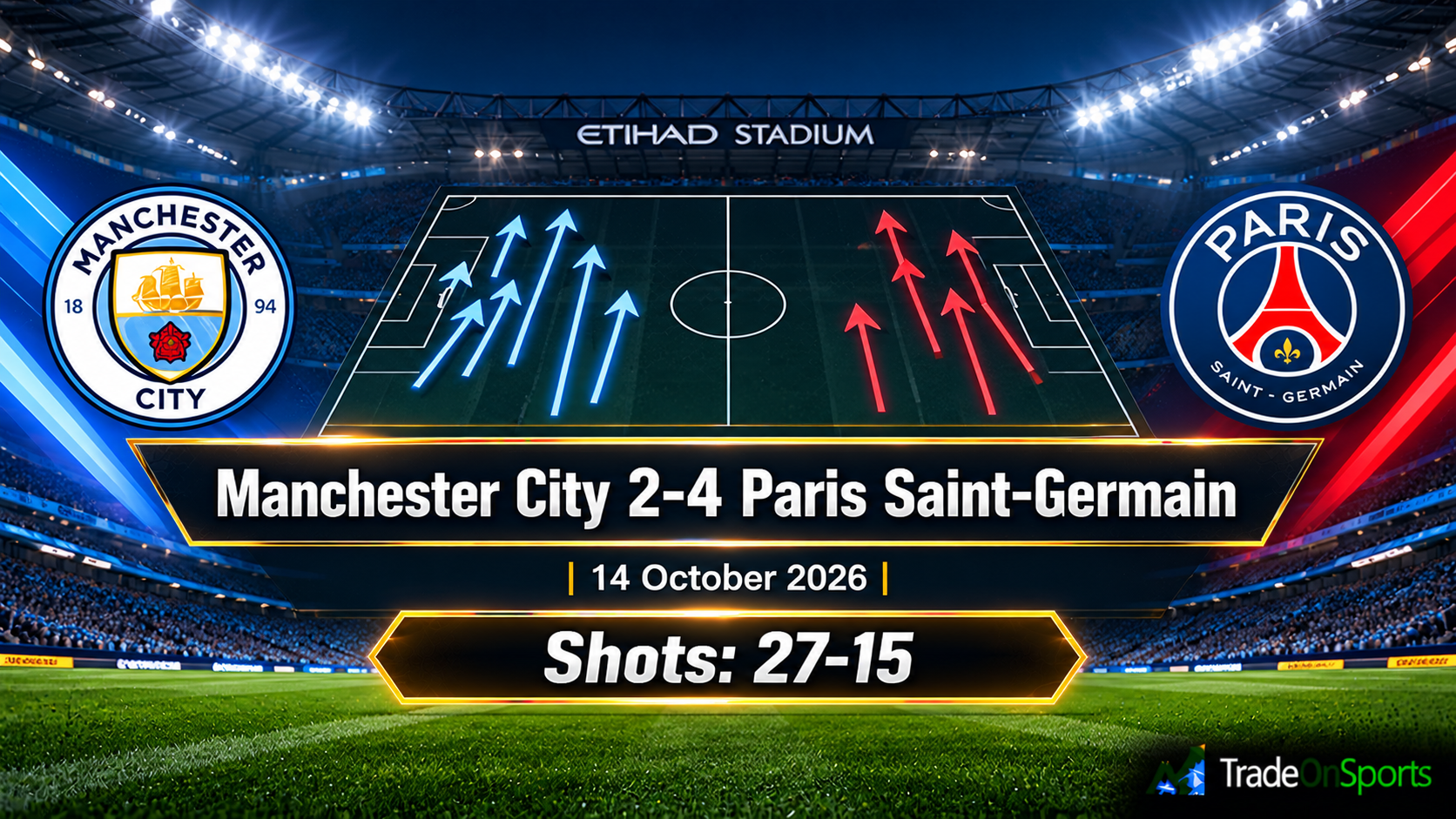
City vs PSG produced a result that asks more of the analyst than a glance at the shot count. Manchester City took twenty-seven attempts at the Etihad on Wednesday and lost 4-2. Paris Saint-Germain took fifteen, but put more of them on target and had already built a commanding lead before the interval. City’s response was real. So was the damage done before it began.
The official Paris report confirms the away win and the first-half advantage. It is the score sequence that gives the totals their context. A team chasing a large deficit and a team protecting one are solving different problems, even when their attempts later appear in the same statistical table.
Paris established the terms early
Desire Doue and Ousmane Dembele scored before Vitinha added another for the visitors. City reached half-time without a goal of their own. That left the hosts needing a response in both the score and the balance of play, while Paris could assess how much space the pursuit might leave behind.
Erling Haaland scored after the break, Maghnes Akliouche added the visitors’ next goal, and Haaland struck again. The completed match report confirms that the double did not reverse the result. The order matters: City did not simply reduce a fixed lead throughout the half. Paris added another goal while the hosts were trying to recover.
This is why a final margin can hide the changing difficulty of a match. At different points, the same attacking decision can have a different purpose. A player may need to force a chance quickly when behind, while the opponent can choose to wait for a more open opportunity. Neither choice can be judged well without the score at the time.
More attempts were not enough
The completed statistics give City nine shots on target and Paris ten. The contrast with the overall attempt totals is useful. City produced more volume; Paris still required the home goalkeeper to deal with more on-target efforts. The result therefore cannot be explained by total attempts alone.
That does not establish an expected-goals value, and we are not inventing one. Attempts from different positions carry different demands. Blocks, placement and the state of the defence all matter. The available count is a reason to examine the chances more closely, rather than a licence to assign a precise probability to what either side should have scored.
For City’s review, the question is which parts of the attacking response were repeatable and which depended on chasing the game. For Paris, the question is how well the early attacking work was supported by the management of later pressure. Winning does not make the conceded goals irrelevant. Losing does not make every home attack worthless.
The table records the points, not the explanations
The final post-result table, checked in this run, places Paris first on six points and City seventeenth on three after two games each. That is a clear difference in current competition position. It is still early in the league phase, and neither club has secured its eventual route through.
Paris can build from a place in the leading group. City need to improve their position. Those are reasonable objectives derived from the current table. They do not require us to make claims about either team’s domestic title prospects or to assume that reputation will settle the remaining European fixtures.
A result like this can tempt an analyst towards an exaggerated correction. One side becomes unbeatable and the other suddenly incapable of competing. Wednesday supports neither conclusion. It shows that Paris built and retained enough of an advantage to win this match. The next opponent and the next score state will still demand a fresh assessment.
What belongs in the next review
We would start City’s video work with the early concessions, then study the quality of the chances created during the response. The order prevents the later attacking volume from hiding the period that made the recovery necessary. It also gives credit to the response without pretending that it recovered the points.
For Paris, the useful material includes the speed at which the advantage was built and the ability to add to it after City replied. Those are observable parts of the completed match. They can guide the next set of questions without becoming an unsupported claim about what the team will do in every future contest.
The score says Paris won. The attempt count says City kept attacking. Both are true, and neither is a complete explanation on its own. The data becomes useful when we retain the sequence, examine the chances and carry only the evidence that can help with the next matchup.
It is also worth separating the chance from the finish when reviewing the footage. A missed effort can follow good attacking work, while a goal can arrive from a difficult position. The result remains fixed; the explanation needs that extra detail.




No comment