
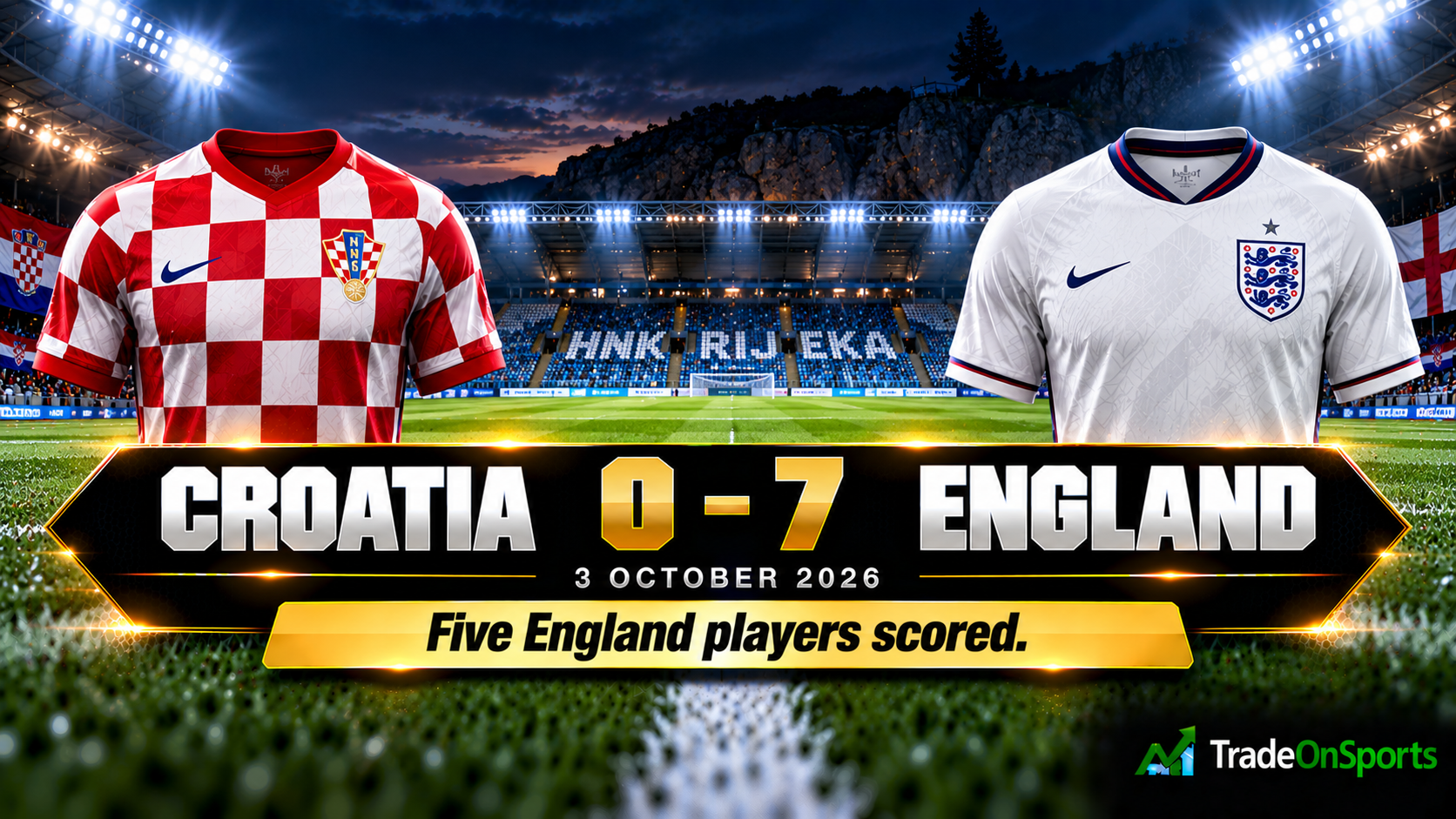
Croatia 0-7 England was a scoreline that left little room for debate about Saturday’s match. Harry Kane and Bukayo Saka scored twice each, Jude Bellingham and Anthony Gordon struck before the interval, and substitute Morgan Rogers added the seventh. England were four goals ahead at half-time in Rijeka. The FA described it as their record UEFA Nations League victory.
The group picture is less dramatic than the score. England are second in A3 with six points from three matches, behind Spain on nine. Croatia have three points and Czechia have none. England have strengthened their position, but they have not secured a place in the next round. A large win and a completed qualification campaign are different things.
England took control early
Kane opened the scoring in the eighth minute after Bellingham played him through. That move gave the evening its first clear pattern: England’s attackers were finding one another before Croatia could close the space. It was a direct combination, finished by the player positioned to make the most of it. There was no need to wait for a late breakthrough.
Bellingham scored in the 21st minute after Gordon kept the ball alive and delivered it across goal. Gordon then headed in Jarell Quansah’s cross in the 39th minute. Saka made it four in the 45th. Four different scorers had contributed before the break, which mattered as much to the shape of the performance as the size of the lead.
Those goals did not come from one repeated action. England scored through a pass behind the defence, a ball worked back across the box, a header and another close-range finish. The official match report records the combinations. We can describe that variety without adding unsourced claims about expected goals, passing networks or the quality of every chance.
The second half added three more
Kane scored again in the 53rd minute, finishing Elliot Anderson’s cross. Saka’s second arrived in the 68th, and Rogers completed the scoring in the 87th after entering as a substitute. The final total was seven goals from five players. Kane and Saka accounted for four between them; the other three came from Bellingham, Gordon and Rogers.
England’s lead was already substantial when the second half began. That is useful context for interpreting what followed. Croatia had to respond to a four-goal deficit, while England could continue attacking with the protection of that lead. The later goals still count fully, but the conditions were different from those at kick-off. A match state changes the decisions available to both sides.
For the same reason, we should resist turning seven goals into a forecast for the next fixture. This was one match against one opponent. It provides strong evidence of how well England combined on the night. It does not establish that every future opponent will leave the same spaces or that the same finishing rate will continue.
What the table now says
The completed-match table places England three points ahead of Croatia and three behind Spain. England’s goal difference is now plus eight; Croatia’s is minus nine. Those figures show how much this result altered the goal balance, but the points remain the first thing to read. England took three from the match, rather than a bonus for the margin.
Croatia remain third, with one win and two defeats from their opening three games. Their immediate problem is therefore twofold: recover from a record loss and close the points gap to England. Calling their campaign finished would go beyond the table. Calling the defeat merely cosmetic would miss both the lost points and the damage to their goal difference.
England have won twice and lost once. Spain’s nine-point total means the group leader still has a perfect record through three matches. That provides a useful check on the excitement generated by Rijeka. England’s attacking performance deserves attention, while the strongest current group position still belongs to Spain. Both statements can be true at the same time.
The lesson for reading a big result
We separate the match report from the projection. The report gives us the score, the scorers, the minutes and the moves that led to the goals. The table tells us what changed in the competition. A projection would require more evidence about future opponents, selection and the level of performance that can be repeated. No numerical forecast is being attached to this result.
The useful takeaway is concrete. England spread their goals across five players, scored four before half-time and increased their advantage over Croatia to three points. Croatia suffered a record defeat and now have ground to make up. That is plenty of information without adding an invented probability or treating an emphatic Saturday win as a promise about what comes next.
The strongest part of England’s evening was the way the goals connected different attacking roles. The strongest part of their group position is the six-point total. We will judge the next performance on its own evidence. For now, Rijeka belongs in the record book, and the qualification contest remains open.




No comment