
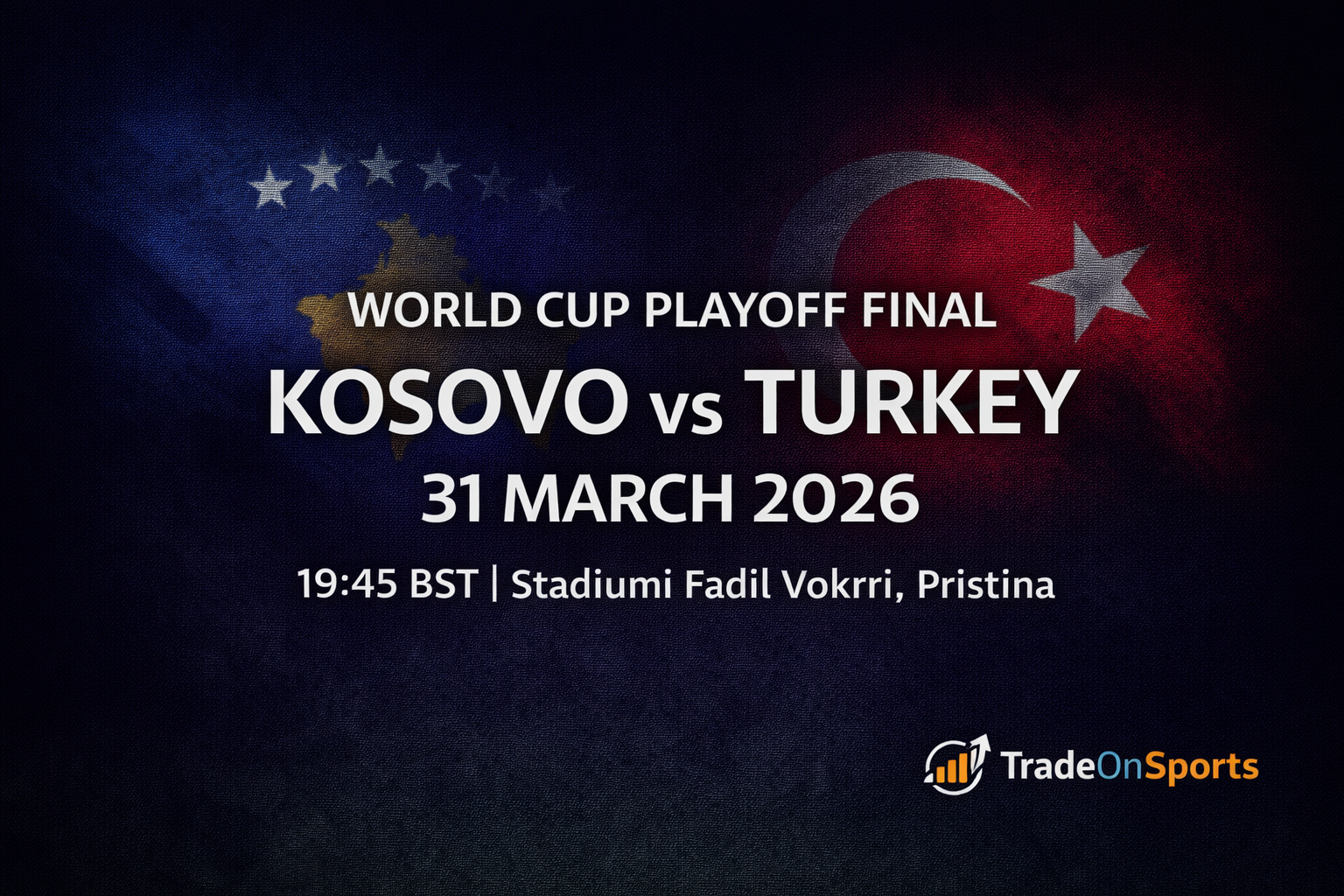
Four World Cup spots are being decided simultaneously across Europe tonight. Kosovo and Turkey know exactly what this match means before a ball is kicked.
Kosovo have never been to a World Cup. They have only existed as a FIFA and UEFA member nation since May 2016. Turkey’s absence since their 2002 third-place finish stretches to 24 years, two full international football cycles without appearing on the sport’s biggest stage. Whatever happens at the Stadiumi Fadil Vokrri in Pristina tonight, one of those narratives ends.
The format is uncompromising: one game, ninety minutes, with extra time and penalties if required. No second legs, no aggregate comfort. The winner goes to Group D at the 2026 World Cup alongside the United States (as co-hosts), Paraguay, and Australia.
The path to this final
Kosovo’s route to the playoff final was the most dramatic of any team in the draw. Their semi-final against Slovakia became the game of the round, a pulsating 4-3 win in Bratislava that required every nerve to be held. Veldin Hodžo, Fisnik Asllani, Florent Muslija, and Kreshnik Hajrizi all scored for Kosovo in a night that announced their arrival on this stage. Vedat Muriqi, Kosovo’s all-time top scorer and captain, leads a team built around collective belief as much as individual quality.
Turkey did the job more efficiently. Ferdi Kadıoğlu, Brighton’s wing-back, scored the only goal against Romania in the 53rd minute, a goal created by Arda Güler, the Real Madrid playmaker who has become central to everything Vincenzo Montella’s side do. One goal, one win, into the final.
Team analysis
Kosovo
Franco Foda has built a Kosovo side that combines defensive discipline with attacking ambition. The system pivots around Vedat Muriqi, Kosovo’s all-time top scorer and captain, who leads the line with physicality and intelligence. Fisnik Asllani provides attacking support, as his semi-final goal against Slovakia demonstrated. Edon Zhegrova brings pace and directness from wide areas. In goal, Arijanet Muric provides calm, experienced presence.
The atmosphere at the Stadiumi Fadil Vokrri, capacity 13,980, almost certainly sold out tonight — will be extraordinary. It is an intimate arena, and the intensity of a Kosovo crowd when history is within reach is something Turkey’s players will need to manage from the opening whistle.
Turkey
Vincenzo Montella has assembled a Turkey side with genuine quality in the key positions. The confirmed absence of Merih Demiral, out with a quadriceps tendon injury, weakens their defensive structure, but the midfield and attack remain formidable. Hakan Çalhanoğlu, Turkey’s captain and Inter Milan’s elite midfielder, is expected to start despite carrying a minor calf concern. His control and range from deep will be central to Turkey’s ability to impose themselves on the game.
Arda Güler is Turkey’s most dangerous creative presence. The Real Madrid attacking midfielder provided the assist for the semi-final winner and, at 20 years old, is playing with a confidence that belies his age. Alongside him, Kenan Yıldız of Juventus adds quality in the final third. Ferdi Kadıoğlu, the scorer in Bucharest, brings energy and end product from a wide-back position.
Key matchup
The most important tactical duel is between Kosovo’s attacking transitions, built on Muriqi’s physical dominance in the channel and Zhegrova’s pace on the counter, and Turkey’s midfield control through Çalhanoğlu. If Turkey can establish possession and allow Güler to operate between the lines, they carry a genuine threat. If Kosovo can disrupt Turkey’s structure and play to their strengths in transition, with the crowd at maximum volume, this becomes a very different match.
Historical context
Kosovo became a FIFA and UEFA member in May 2016. Their first World Cup qualifier was played against Finland in September 2016 — a 1-1 draw. Nine years of building towards a moment exactly like this. For Turkey, 2002 was a high-water mark: a third-place finish in Japan and South Korea, with Hakan Şükür scoring the fastest goal in World Cup history in the third-place playoff against South Korea. Just two World Cup appearances in their entire history, 1954 and 2002. Tonight is the moment to reclaim their place on football’s biggest stage.
Our lean
Kosovo’s emotional advantage at home in Pristina is real, the crowd will be a factor, and Muriqi in this form is a genuine threat to any backline. But Turkey carry more international experience at this level and have Çalhanoğlu and Güler as genuine match-winners capable of deciding a game in a single moment.
Turkey’s quality in the key positions points toward them finding a way through over 90 minutes. But this is precisely the type of match, one-off final, hostile stadium, opposition with everything to play for, where Kosovo’s collective energy and the weight of potential history can narrow the gap between the sides significantly.
Whatever the outcome, at least one nation will have its world changed by the final whistle.
Statistics sourced from UEFA.com, VAVEL, and official competition data where noted. Data correct at time of writing.





No comment