
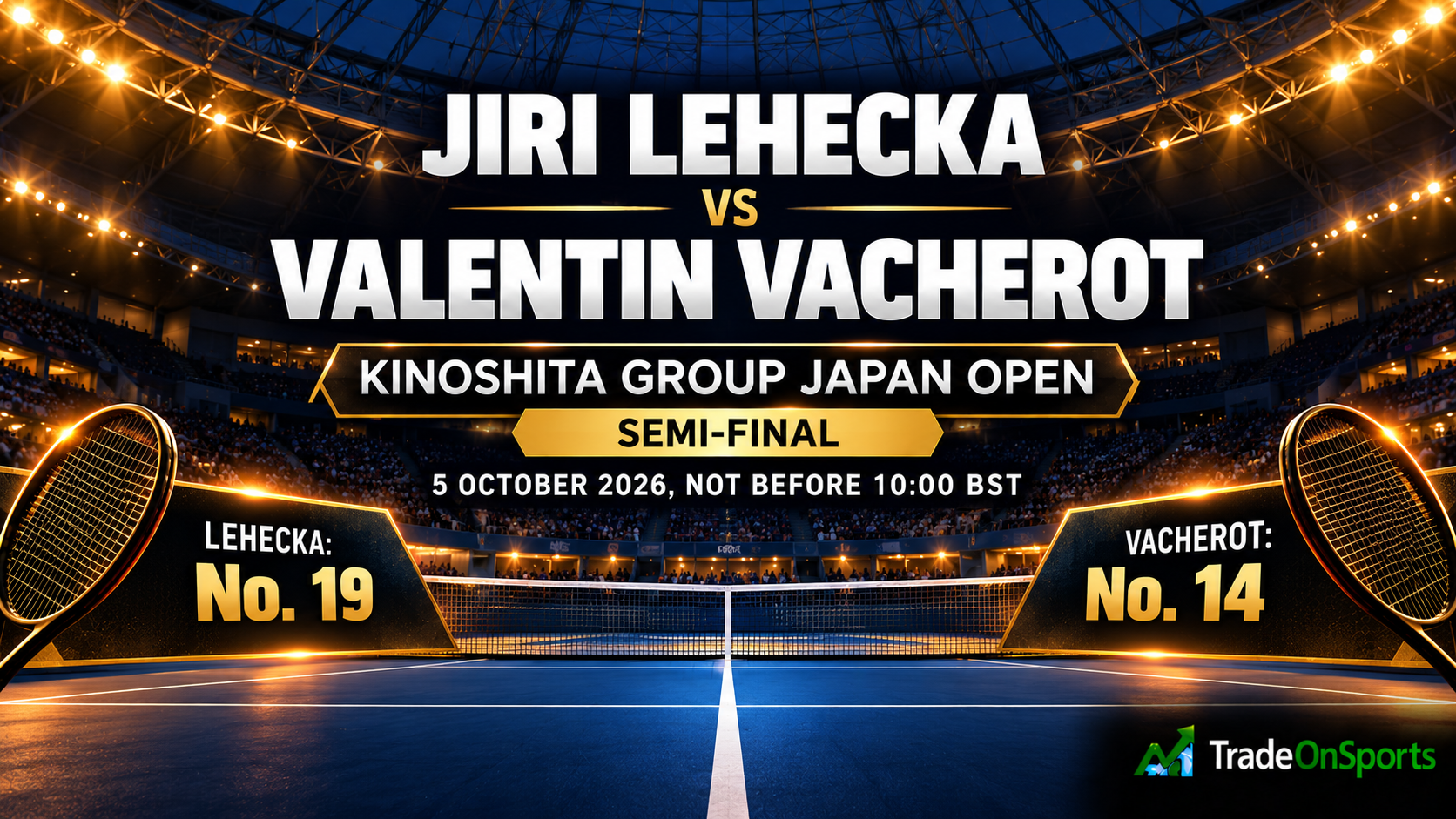
Lehecka vs Vacherot is Tokyo’s second confirmed singles semi-final, with a smaller ranking gap than the other side of the draw. Jiri Lehecka is No. 19 in the current published ATP rankings. Valentin Vacherot is No. 14. Their Japan Open match is scheduled not before 10:00 BST on Monday.
The quarter-final scores provide a sharper contrast than those ranking positions. Lehecka beat Adolfo Daniel Vallejo 6-1 6-1. Vacherot beat Arthur Fils 7-5 4-6 6-4. Both results are official; both earned the same next-round place. The task now is to assess a new opponent rather than simply compare the margins.
The final place at stake
This is a hard-court semi-final at Ariake Colosseum. The singles draw began with 32 players and uses the best of three tie-break sets.
The winner advances to Tuesday’s final against the winner of Carlos Alcaraz versus Jaume Munar. That opponent is not yet confirmed.
The match is listed after the earlier semi-final, with a not-before time. The schedule therefore gives the earliest start rather than an exact promise. Readers following from the UK should check the current official order of play if the earlier court programme runs longer.
Lehecka’s current tournament evidence
Lehecka is unseeded in the Tokyo draw, but his current published ranking is No. 19. Those labels should remain separate.
His 6-1 6-1 quarter-final win is a clear completed result. The score shows a large separation in games against Vallejo. It does not report a measured serve speed, a rally-length average or a verified chance of winning the next match.
He has three main-draw wins in the current tournament. That is the route which places him in the semi-final, rather than a historical assumption about how he should perform on this surface.
The latest score is positive evidence. It deserves to be included without becoming a claim that every future opponent will face the same outcome.
Vacherot’s current tournament evidence
Vacherot is the eighth seed and world No. 14 in the latest published ranking table. He won the opening set against Fils, lost the second and won the third.
The completed 7-5 4-6 6-4 score shows a match that remained contested across all three sets. Vacherot still secured the result required to progress.
His three main-draw wins give him the same current tournament stage as Lehecka. The route took a different shape in the latest round, but progression is confirmed for both.
A higher current ranking supports Vacherot’s side of the comparison. A closer latest score does not automatically weaken that comparison, because it was produced against a different opponent.
Why score margins need opponent context
Lehecka’s quarter-final looks more emphatic on the scorecard. Vacherot’s required a deciding set. That is a valid description of their latest matches.
It is not enough to establish which player is stronger in this matchup. The opponents differed, and the score does not contain every detail of how the points were played.
We would need verified match statistics to make a more detailed comparison of serve effectiveness, returning or rally patterns. Those figures are not being invented to fill the space between two known scores.
Set count also does not measure recovery. We can record two sets versus three without assigning a quantified physical advantage or an unverified health concern.
The hard-court questions to follow
The opening exchanges will show how each player establishes position after serve and return. A strong first attacking ball can create a short point; a deep return can force a different response.
If one player is moved wide, the next shot changes which parts of the court are available. We will follow whether he can recover position or whether the opponent can use that space.
These are conditional observations rooted in the match being played. They do not claim that either player has a fixed tactical weakness established by unsourced data.
The useful live assessment will connect those observations to the actual points. A final score can tell us who won; explaining why requires the completed evidence.
A post-match review should preserve the same distinction. We can assess which serve and return exchanges mattered once they are documented, while avoiding the claim that the winning player proved every pre-match argument correct.
Our outlook
The current ranking order gives Vacherot a narrow qualitative lean. Lehecka’s emphatic completed quarter-final keeps the assessment close and prevents the seed labels from doing all the work.
No odds, model percentages or head-to-head total are supplied. We are also not treating a three-set quarter-final as a guarantee of tiredness.
The confirmed facts provide enough substance: No. 19 against No. 14, an unseeded player against the eighth seed, and two different recent wins. The new contest still needs to determine which evidence matters most.
At TradeOnSports, we judge the matchup rather than award the next round to the more impressive-looking score. I




No comment