
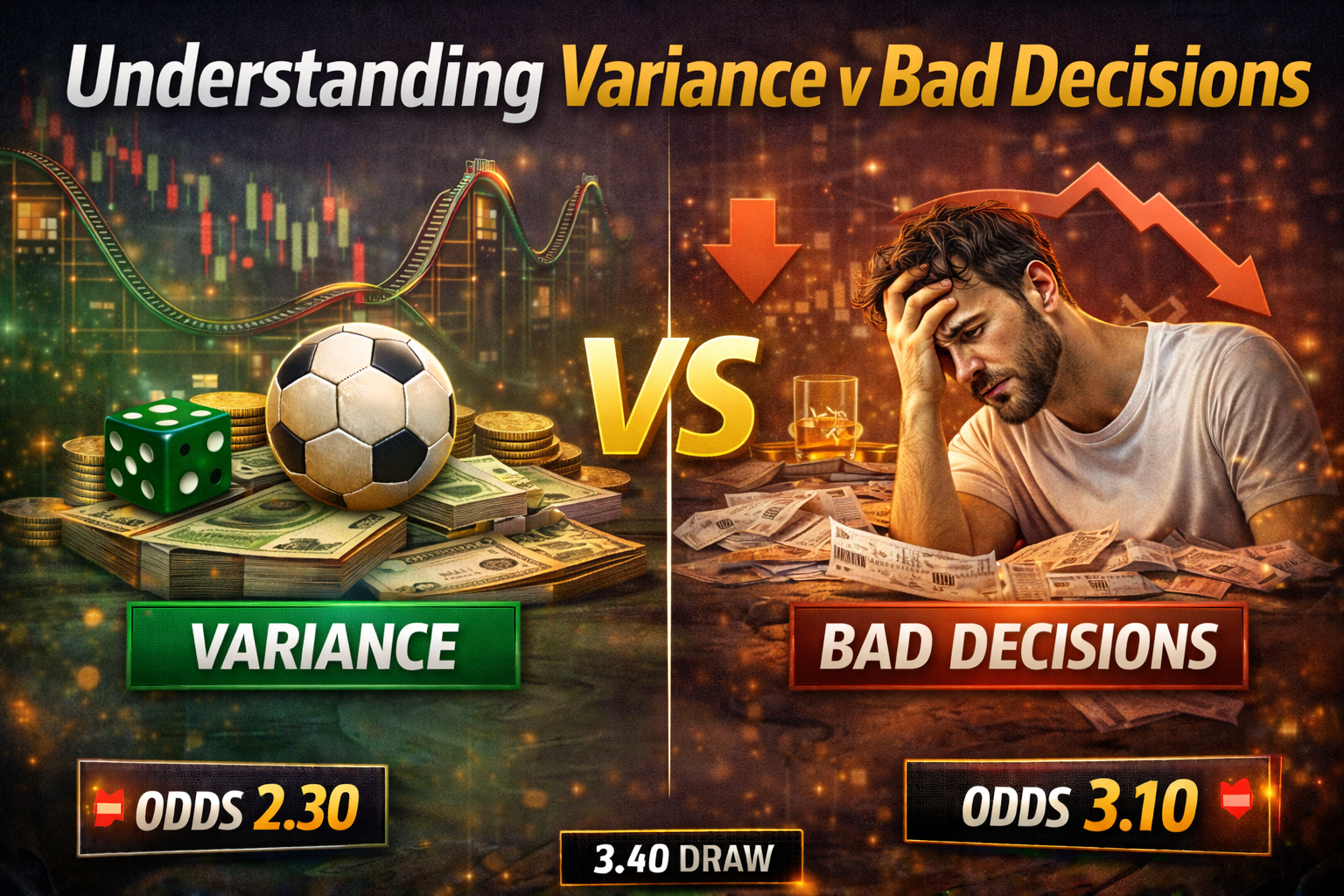
When I first started trading, every loss felt personal. If a trade went against me, I assumed that I had done something wrong. If a trade won, I assumed I was a trading genius.
It took time and a lot of painful journaling and record keeping accepting a simple truth: Not every loss is a mistake, and not every win is good trading.
This distinction is one of the most important in sports trading and most traders get it wrong.
Today I am going to be looking at separating variance from bad decisions.
Variance: The Part You Do not Control
Variance is simply randomness. It is the bounce of a ball, an unexpected injury, a late goal, a sudden momentum shift.
You can make a perfect, stats driven decision where you believe you have an edge and still lose the trade. However, this does not make it a bad trade.
Variance is simply the price you pay to sit at the table. You do not and cannot eliminate it. However, with the right mindset you can outlast it.
Variance is the number one reason aspiring traders fail to become competent as a bad run either wipes them out financially or emotionally.
Bad Decisions: The Part You Do Control
Bad decisions come from:
- Acting without criteria
- Scaling up through emotion, especially after a good winning run.
- Chasing after losses
- Taking trades that do not meet all your rules.
- Ignoring your own risk rules
These are the things that compound negatively over time. Variance hurts you in the short term, but bad decisions ruin you in the long term.
It is almost impossible to eliminate mistakes. However, you should be eliminating repeat mistakes.
A Simple Framework I Wish I had Learned Earlier
After every trade, you should always ask thew question: Was this a good decision, regardless of the outcome?
If the process was sound but the trade lost, that’s variance. Learn from it, but do not internalise it.
If the process was weak but the trade won, that’s luck. Do not celebrate it, learn from it.
This mindset shift is where real growth begins.
How to Build the Skill of Differentiating the Two
- Write down your reasoning before placing a trade. Do not do this afterwards as here you are facing and standing up to the truth of your decision.
- Record each trade as either a process or result win/loss. This should then highlight that over the long-term sticking with your plan is more successful.
- Review in batches, not single outcomes. It may sound as though I am repeating myself, but you must look and think long term.
- Detach emotionally from individual results. The trader who evaluates behaviours, not moments, improves faster than everyone else.
Final Thought
Most traders let variance damage their confidence and let luck inflate their ego. Both are dangerous. Your job is not to control outcomes it is to control your decisions.
When you consistently make good decisions, variance becomes noise and your edge becomes visible.


No comment