
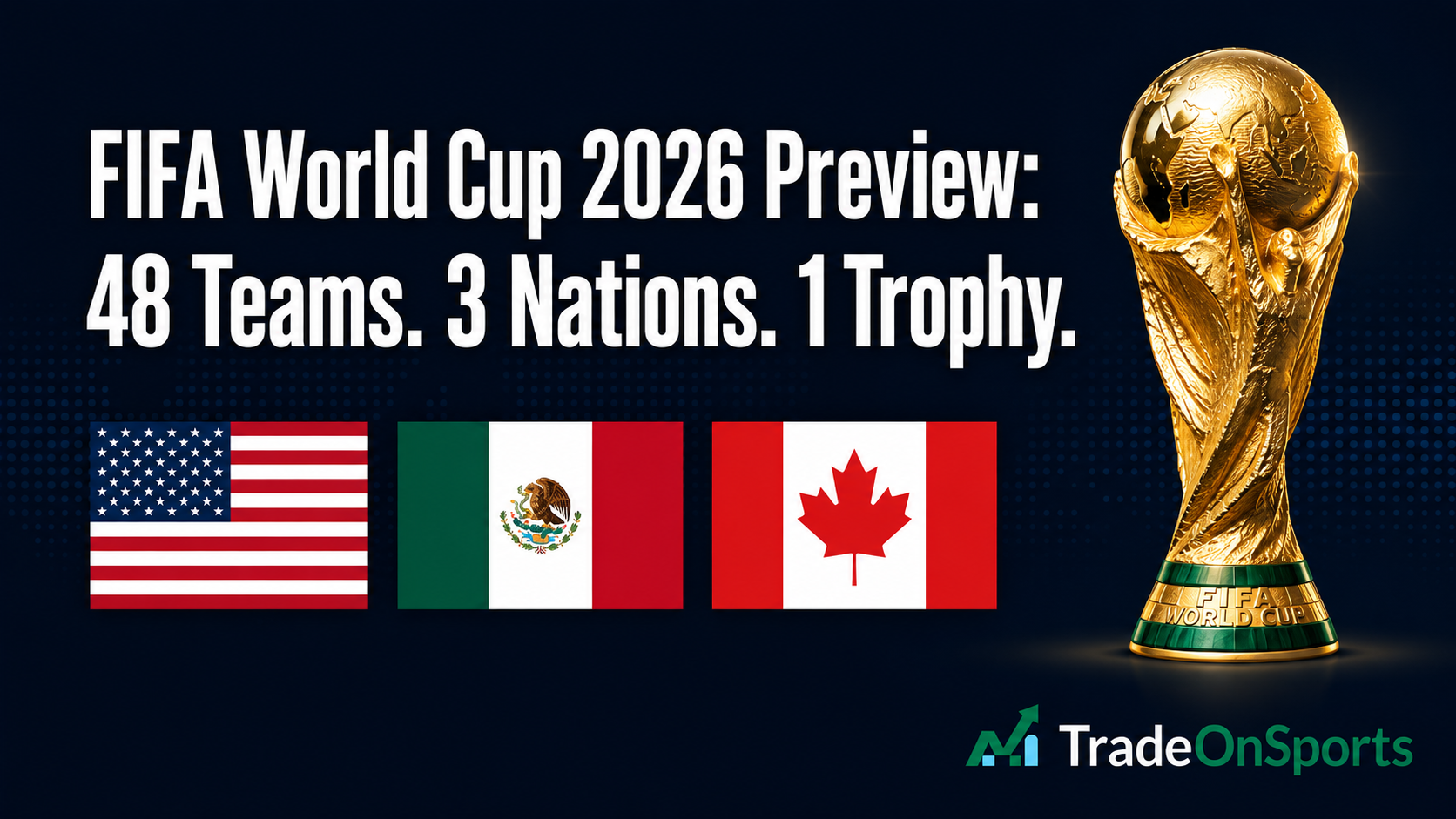
FIFA World Cup 2026 Preview
Football’s greatest event returns on Thursday, and this time it arrives bigger than anything that has come before. Forty-eight nations. Three host countries. One hundred and four matches. The FIFA World Cup 2026 is a genuine shift in scale, and for UK fans, the fixtures start immediately.
What It Is and Why It Matters
The tournament runs from June 11 to July 19, 2026, spread across 16 cities in the United States, Canada and Mexico. The final takes place at MetLife Stadium in East Rutherford, New Jersey, on July 19. It is the first World Cup co-hosted by three nations, and the first to feature 48 teams after FIFA expanded the field from 32.
That expansion matters beyond the headline numbers. With 48 teams and 104 matches, the group stage alone runs for nearly three weeks. There is more football, more exposure for smaller nations, and more opportunities for upsets. The scheduling means UK fans will have wall-to-wall coverage from the opening match on Thursday through to the final six weeks later.
How the Format Works
The 48 teams are split into 12 groups of four (Groups A to L). Every team plays three group-stage games in a round-robin. The top two from each group advance automatically to the Round of 32. The eight best third-placed teams across all 12 groups also advance, giving a total of 32 nations entering the knockout rounds. Four third-placed teams go home.
From the Round of 32, it is straight knockout football through to the final. Tiebreakers for third-placed teams use points, then goal difference, then goals scored, then team conduct score, then FIFA ranking.
The format creates jeopardy. A team that loses its opening game is not dead but does need to respond quickly with only two games remaining.
The Opening Match: History at the Azteca
The tournament opens on Thursday June 11 with Mexico hosting South Africa at the Estadio Azteca in Mexico City. Kick-off is at 3pm local time (8pm UK). The Azteca becomes the first stadium ever to host three World Cup games, having previously staged the 1970 and 1986 finals. The occasion gives Mexico’s Group A opener extra weight.
Group A also contains South Korea and Czechia. Mexico will expect to advance. The real question is who joins them.
Key Storylines
Argentina defend with Messi in doubt. The reigning champions are back, led by a 38-year-old Lionel Messi who arrives carrying a hamstring concern. He sat out Argentina’s pre-tournament friendly against Honduras on June 7 with what Inter Miami described as a muscular overload. Argentina coach Lionel Scaloni said the initial reports were “not that bad” and confirmed Messi remains in the 26-man squad, targeting fitness for their Group J opener against Algeria on June 16 in Kansas City. Argentina are priced around +950 to lift the trophy. The question is how much Messi the world gets to see.
Spain and France arrive as co-favourites. Spain head into the tournament as the bookmakers’ narrow favourites at approximately +450, with France close behind at +475. Spain are the European champions and arrive with one of the deepest squads in the tournament. France have Kylian Mbappe and a blend of experience and pace that makes them dangerous from any position in the bracket. These two could meet in the final. The odds suggest that is the most likely showdown.
England: the weight of Dallas. England open against Croatia on June 17 at AT&T Stadium in Dallas, 9pm BST. It is a familiar fixture with familiar expectations. England are priced at approximately +650, third in the betting, and Thomas Tuchel’s side have the squad depth to go deep. Group L also contains Ghana and Panama, which makes the group very manageable. The real test comes in the knockout rounds.
Scotland’s 28-year wait is over. Scotland are back at a World Cup for the first time since France 1998. They open against Haiti on June 13 at Gillette Stadium in Foxborough, Massachusetts. The group also contains Brazil and Morocco, which means the path out of Group C is steep. But the fact of qualification alone carries real meaning for Scottish football after nearly three decades away. The historical echo is striking: just as in 1998, Scotland and Brazil share a group with Morocco.
Italy are absent again. The four-time world champions failed to qualify for a third consecutive World Cup, losing a European play-off final to Bosnia and Herzegovina. It is a staggering underperformance for a nation of Italy’s standing, made worse by the fact the field expanded to 48 teams. Gennaro Gattuso left the head coach role in April following the failure. Nigeria also missed out, as did Denmark and Poland, with the likely curtain falling on Robert Lewandowski’s Poland career.
First-time qualifiers on the world stage. The expanded format brought in new faces. Curaçao, Cape Verde, Jordan and Uzbekistan all appear at a World Cup for the first time. Cape Verde are in Group H with Spain and Uruguay. Curaçao face Germany in Group E. These debuts are one of the genuine features of the new format.
Teams to Watch
Spain (+450) arrive as the defending European champions with a squad built around positional excellence and relentless pressing. Their Group H contains Saudi Arabia, Uruguay and Cape Verde, which is very navigable.
France (+475) have the attacking firepower to win any single game. Mbappe leads, supported by a midfield depth that few can match. Group I contains Senegal, Norway and Iraq.
England (+650) have experience in the squad at a level previous England sides lacked. Marcus Rashford, Phil Foden, Jude Bellingham and Harry Kane give them multiple match-winners.
Brazil (+850) are the highest-ranked non-European side in the betting. In Group C with Scotland, Haiti and Morocco, they should advance comfortably. The deeper question is whether this Brazil squad can translate South American dominance to a global stage.
Portugal (+900) have a midfield arguably stronger than any other side in the tournament, built around Joao Neves, Vitinha and Bruno Fernandes. They are in Group K with Colombia, DR Congo and Uzbekistan. If Cristiano Ronaldo contributes, Portugal could go further than their ranking suggests.
Argentina (+950) are the champions and cannot be dismissed regardless of Messi’s fitness. They have tournament experience at the deepest level.
Germany (+1300) have re-established themselves as a serious force. Group E with Ecuador, Ivory Coast and Curaçao is very winnable.
USA (co-hosts) face a defining tournament at home. Under Mauricio Pochettino, they have Christian Pulisic leading a young squad that includes 13 players from the 2022 side. Group D against Paraguay, Australia and Türkiye is theirs to lose. Anything short of the knockout rounds would be a real disappointment.
Dark Horses Worth Watching
Morocco reached the semi-finals in Qatar 2022, beating Spain and Portugal on the way. The loss of coach Walid Regragui in March 2026 creates uncertainty, but the squad has the defensive organisation to cause problems for any side.
Norway are back at a World Cup for the first time in 28 years. They went unbeaten through qualifying and beat Italy over the course of the campaign. Erling Haaland gives them a striker who can decide games in a single moment.
Colombia have James Rodriguez, Luis Diaz and a depth of attacking talent that can threaten anyone in the knockout rounds. They are in Group K with Portugal, which sets up a fascinating contest.
Opening Week to Watch
A genuinely packed first week of fixtures includes:
- June 11: Mexico vs South Africa, Estadio Azteca, Mexico City, 8pm UK
- June 12: USA vs Paraguay, SoFi Stadium, Los Angeles, 2am BST (late/early UK)
- June 13: Scotland vs Haiti, Gillette Stadium, Boston, 2am BST — Scotland’s first World Cup match in 28 years
- June 13: Brazil vs Morocco, MetLife Stadium, New Jersey, late evening UK
- June 16: Argentina vs Algeria, Arrowhead Stadium, Kansas City — Messi’s likely tournament debut
- June 17: England vs Croatia, AT&T Stadium, Dallas, 2am BST
The schedule runs into the small hours for UK viewers on many nights, so setting the alarm is part of the deal.
The Bottom Line
Spain and France carry the strongest probability of lifting the trophy on July 19 at MetLife Stadium. Argentina will be limited by how much Messi can offer across six or seven matches at 38 years old. England have the squad but need the knockout-round composure they have historically lacked.
The expanded format makes early upsets more survivable, which helps the giants. But it also gives dark horses like Norway, Morocco and Colombia more time to build momentum.
One thing is certain: with 104 games across six weeks and three nations, this is the longest sustained run of top-level international football ever staged. For sports traders, the value opportunities across the group stage alone are significant.



No comment