

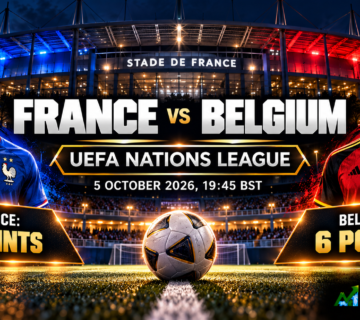
France 4-1 Belgium looks like a comfortable home win until the goals are put back in order. Belgium led at the interval. France did not equalise until the 77th minute, then scored four times in a late burst to take control of Nations League Group A1. Michael Olise supplied the last two goals.
The result leaves France first and Belgium third. Italy’s 3-1 win over Türkiye on the same evening moves them into second. Belgium have lost more than a match: they have also lost their place in the group’s leading pair.
The lead Belgium could not hold
Dodi Lukebakio put the visitors ahead in the first half at the Stade de France. That goal gave Belgium a position from which to threaten the group leader, rather than merely trying to limit the damage.
The advantage survived half-time and much of the second period. France’s eventual three-goal margin therefore conceals a long stretch in which the home side still needed an equaliser.
There is a difference between reporting a commanding final score and describing control throughout a match. Here, the sequence rules out the latter. The result was earned through the closing response, not an uninterrupted lead.
Four goals change the account
Desire Doue levelled in the 77th minute. Rayan Cherki put France ahead four minutes later, with Olise providing the assist. Olise then scored in the 88th minute and added another in stoppage time.
UEFA describes four goals in 14 second-half minutes. The speed of that change is the clearest feature of the match: Belgium moved from protecting a lead to losing by three goals before the game ended.
The names also show the impact available from France’s bench. UEFA’s report credits the second-half changes with helping turn the contest. We can describe that contribution without inventing a substitution metric or a dressing-room explanation.
Olise’s involvement covers both creation and finishing. His assist for Cherki gave France the lead; his own goals extended it. A headline about the double is accurate, but the assist belongs in the match account too.
The group position after the result
France have 10 points after the four-match window. AFP’s post-match account places Italy three points behind and Belgium a further point back. That gives Italy seven and Belgium six by direct arithmetic from the reported gaps.
France therefore retain the lead, while Belgium now have a top-two place to recover. The immediate goals are different: France seek to turn their strong position into quarter-final qualification; Belgium need to climb back above a rival.
The win should not be described as confirmed qualification. The result strengthens France’s position, but the available post-match account does not establish that their place is already mathematically secured.
For Belgium, third is a current position rather than a final verdict. Their campaign continues. The damaging part of Monday is that the late concession sequence cost them the result while Italy collected points elsewhere.
What the margin can and cannot show
Four goals tell us what France produced. The timing tells us when. Neither supplies a verified expected-goals figure, a possession share or a measure of how repeatable the late burst is.
At TradeOnSports, we keep those distinctions in the analysis. Belgium’s first-half goal and long-held lead matter because they show the contest France had to overturn. France’s closing response matters because it decided the points.
The table now records the practical consequence: France first, Italy second, Belgium third. Monday’s comeback is complete. The next qualification question belongs to the remaining group matches, with the current points rather than the size of this scoreline as the starting point.
The simultaneous result belongs in the story
Belgium’s move to third cannot be explained by the Paris score alone. Their defeat left them without new points, while Italy’s win added three. The group order reflects both matches.
That is a simple distinction with practical value. A team can lose without changing position if a rival also fails to gain ground. Here, the rival collected the result needed to move above Belgium. The table consequence is therefore part of the evening, rather than an adjective attached to the comeback.
The points gaps also help keep the qualification language accurate. France’s lead over Italy is three points, with Belgium another point behind. That is a strong position, but reporting it accurately does not require declaring the remaining matches irrelevant.
There is a further limit in the late-goal sequence. Four goals in a short period show a decisive burst. They cannot be treated as a scoring rate that will continue in the next match. The earlier part of the game, when France were behind, supplies a reason to resist that extrapolation.
Belgium’s assessment needs the same restraint. Losing a long-held lead was costly, and conceding repeatedly at the end widened the defeat. Those events establish Monday’s problem. A wider judgement about their future chances needs the current group position and fresh match evidence, rather than the final margin by itself.
We will assess the next match from its own recorded points and completed result. Past evidence informs the questions we ask; it does not settle a contest that has yet to be played.



No comment