
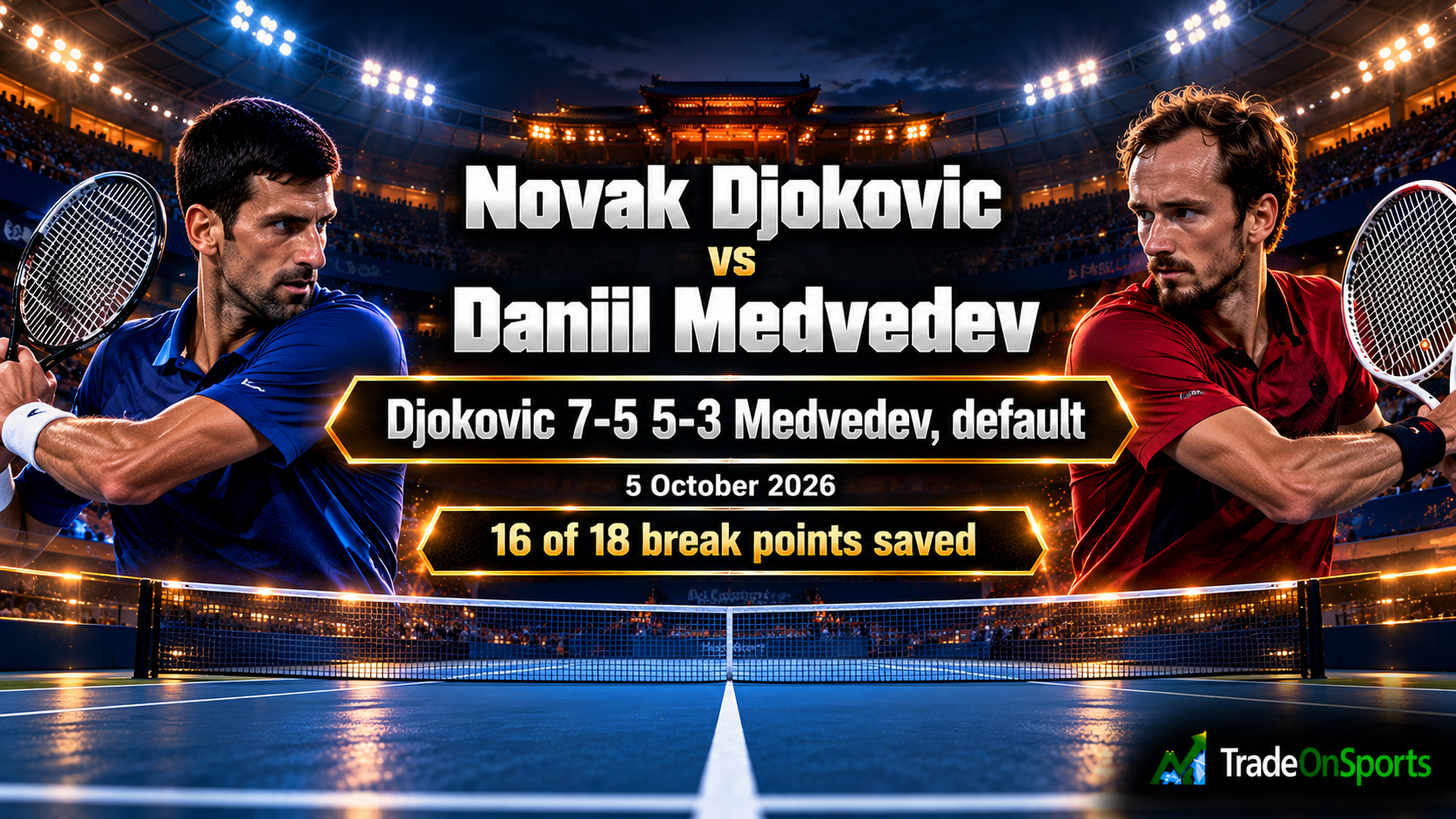
Djokovic vs Medvedev ended with a default, not a completed second set. Novak Djokovic was leading 7-5 5-3 when Daniil Medvedev was disqualified from their China Open semi-final on Monday after hitting a spectator with a ball. Djokovic advances to face Alex de Minaur in the final. Medvedev’s Beijing campaign is over.
The incident will dominate the reaction. The tennis before it deserves attention too. Djokovic saved 16 of the 18 break points he faced, surviving repeated pressure on serve while taking more of his own opportunities. That is the clearest statistical explanation for the lead he held when the match stopped.
Pressure without enough reward
Medvedev created 18 break-point chances and converted two. Djokovic created 10 and converted four. Both players had openings, but the scoreboard rewarded the player who made better use of them.
Those are opportunities, rather than a count of separate service games under pressure. A long game can contain several break points. The distinction matters: Medvedev’s total shows repeated chances to break, while the conversion figure shows how few became actual changes on the scoreboard.
Djokovic’s saving rate should therefore be read alongside Medvedev’s creation of those chances. This was resistance under pressure. It was not a semi-final in which the eventual finalist sailed through every service game.
The serve figures reinforce that reading. Djokovic recorded three aces and six double faults. Medvedev had four aces and three double faults. An ace tally alone would point in the wrong direction if used to explain who held the match advantage.
Why the ending needs its own label
The official draw records the result at 7-5 5-3 with a default marker. The second set did not reach a normal finish. Calling this a routine straight-sets win would erase the event that actually settled the contest.
Djokovic already had the first set and a lead in the second. That made his position favourable on the scoreboard, but a lead is not a result until the match ends. The default supplied that ending.
We should also keep the report of the spectator incident within what has been confirmed. The available reporting establishes the ball strike and the disqualification. It does not justify adding a medical diagnosis, guessing intent or announcing a later sanction.
What changes in Beijing
The completed bracket now has Djokovic and de Minaur in the title match. For Djokovic, Monday keeps the immediate tournament objective alive. For Medvedev, there is no further singles round here.
That is the verified competition impact. We are not assigning either player a new world ranking or a Race to Turin position from an unverified live projection. Tournament advancement and a season-long points table answer different questions.
For the final, the semi-final provides evidence of Djokovic’s ability to survive difficult service games. It also supplies a reason to watch how often his next opponent can put the serve under pressure. Neither observation predicts how the new match will finish.
The data takeaway
At TradeOnSports, we separate the performance from the way a match was decided. Djokovic’s break-point defence explains much of the position he earned. Medvedev’s default explains why the contest ended at that position.
Both belong in the account. Ignoring the tennis would reduce the match to one incident; ignoring the default would misreport the result. The final will start with a new opponent and a fresh scoreboard.
A different kind of comparison
Break-point creation and conversion deserve separate treatment because they describe different achievements. Medvedev repeatedly reached a score from which one point could take Djokovic’s serve. Djokovic repeatedly won that next contest. Neither figure cancels the other.
There is a practical reason to retain the fractions. Two conversions from 18 chances and four from 10 tell a clearer story than a rounded percentage alone. The difference in actual breaks is what appears in the service-game pattern, while the opportunities explain the pressure behind it.
The default creates another limit. Statistics from an unfinished match cover the points played before the stoppage. They cannot describe a second set that reached six games for its winner, because that finish did not happen.
A comparison with another semi-final would also need the ending attached. A player who advances after a default and a player who completes a normal match have both progressed, but the recorded demands of those matches differ. Without verified physical information, that difference should not become a claim about which finalist has recovered better.
The next report should begin with the final’s actual performance. Monday’s break-point resistance is relevant background, and Monday’s ending remains an unusual result. Neither supplies an automatic answer to a new match. That is the boundary between useful evidence and a forecast carrying more confidence than its source can support.
We will assess the next match from its own recorded points and completed result. Past evidence informs the questions we ask; it does not settle a contest that has yet to be played.





No comment