
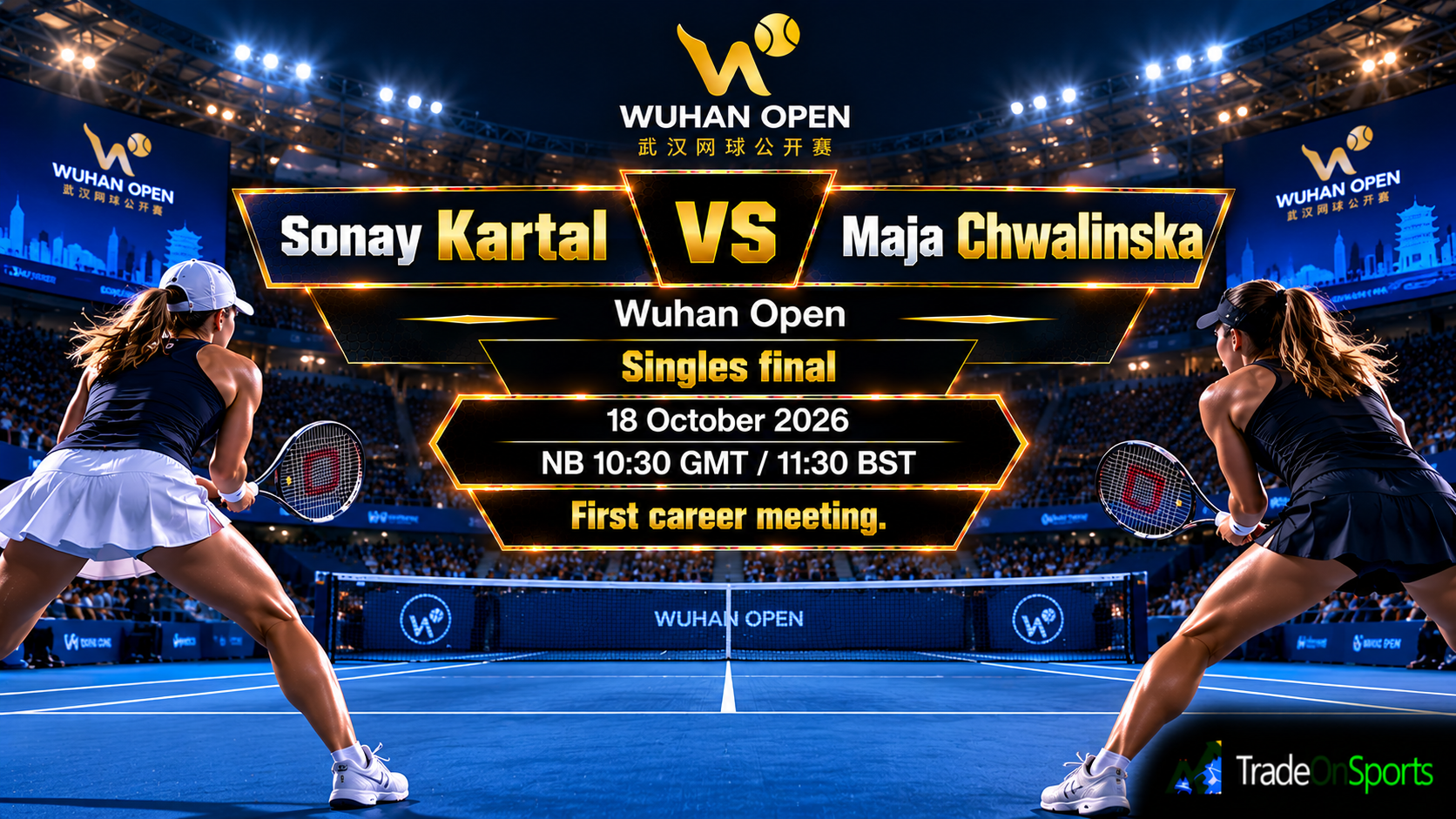
Kartal vs Chwalinska is a Wuhan final that asks for more than a glance at the ranking list. Sonay Kartal is world No. 170 and Maja Chwalinska No. 22 in the fresh official WTA records checked for this preview. Both have won their way into Sunday’s title match, and neither has won a WTA 1000 trophy. The WTA final guide confirms their first career meeting. The numbers describe different starting positions; the week’s results explain why both players are here.
The final is on outdoor hard courts at the Optics Valley International Tennis Centre. The advertised singles start is not before 18:30 in Wuhan, which is 10:30 GMT and 11:30 BST. The UK remains on summer time, so British viewers should use the BST time for their clocks. A not-before listing is an earliest start rather than a promise that the first point will be played at that exact minute. Check the live order before settling in.
Kartal’s number needs the comeback context
Kartal’s official weekly ranking history lists No. 170 for 12 October. Her current position follows a lengthy period away with a back injury, so the ranking should not be mistaken for a complete description of her level this week. The WTA’s assessment of the finalists records seven wins from eight tour matches since her return and only one set lost through five Wuhan victories. Those are recent results, rather than a projection based on what she used to do.
Her semi-final against Jelena Ostapenko was much closer than a straight-sets label might suggest. Kartal won two tie-breaks and saved six set points. That matters for the final preview because it separates the outcome from the degree of control. She found ways to survive and finish the sets, but she was also close to having to play a different match. The useful takeaway is her ability to keep competing through difficult positions, not a claim that future tie-breaks will automatically go her way.
On a hard court, the first questions we would watch are practical. Can Kartal keep enough depth on her return to avoid beginning too many rallies under pressure? Can she protect her own service games without relying on repeated escapes at the end of a set? These are questions for the match, rather than claims about a measured weakness in her game. The semi-final gives us a reason to watch the opening exchanges closely; it does not provide a ready-made answer against a new opponent.
Chwalinska has another final in her season
Chwalinska’s current official ranking is No. 22, and the tournament lists her as the 16th seed. Her place in the final follows a 7-5, 6-1 win over Iga Swiatek. Earlier in the year she reached the Roland Garros final. The recent WTA assessment also records an 8-2 run during the Asian swing. That provides a current-season basis for discussing her challenge on hard courts, rather than treating the Paris result as the only relevant performance in her record.
Her semi-final needs the same care as Kartal’s. Chwalinska saved two set points before taking the opening set, while Swiatek reported a physical problem. The win is confirmed, but the injury context limits how confidently we can transfer the later score into Sunday’s matchup. Chwalinska still had to keep the first set alive and complete the victory. A different opponent will bring different patterns, and there is no reason to assume that a wide second-set margin will simply appear again.
The WTA describes variety as a feature of Chwalinska’s game. In a first meeting, changes of height, pace and direction can test how quickly an opponent finds a comfortable response. The question is whether those changes create opportunities or leave too much time for the other player to organise. We will watch that exchange rather than presume that variety alone decides the contest. On this surface, the quality of the next ball remains as important as the decision to change the previous one.
What to watch before choosing a favourite
There is no previous career meeting to use as direct evidence. That makes the opening service games particularly useful for identifying which patterns each player prefers. It also limits the value of confident claims about one player having the other’s measure. Rankings, recent results and style descriptions are useful inputs. They are not substitutes for a match history that does not exist, and we will not fill that gap with invented percentages or a model output that has not been supplied.
Our outlook is open. Kartal’s recent results make her ranking alone a poor shortcut; Chwalinska’s current season supplies evidence beyond a single upset. Both have already handled pressure to reach this final, but the title still requires another completed performance. We would pay closest attention to return depth, the quality of the first rally ball and how each player responds when an early plan stops working. Wuhan will have a new WTA 1000 champion. The identity of that champion remains to be decided on court.



No comment