
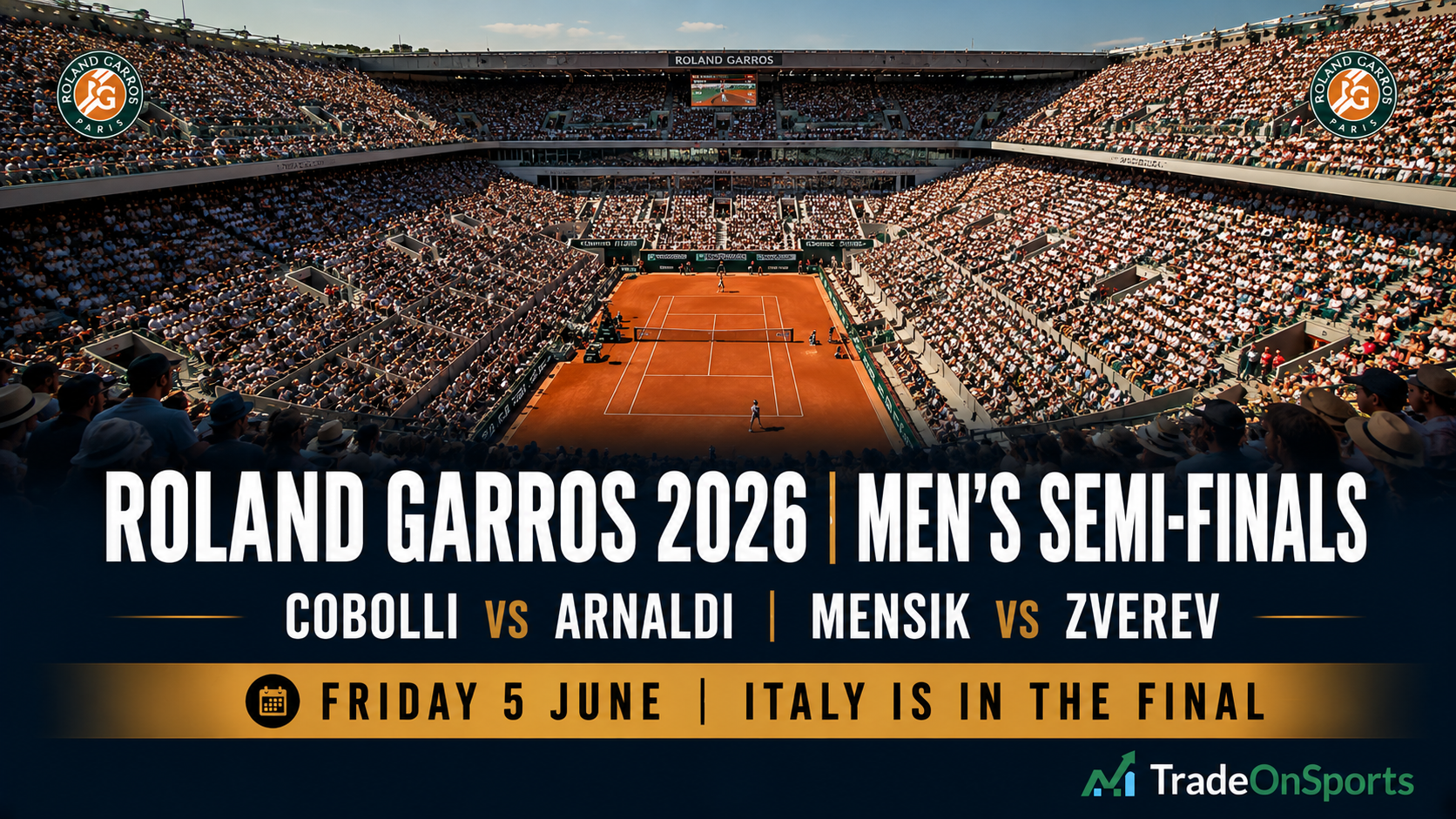
Italy will be in Sunday’s Roland Garros Men’s Final. We know that already.
Flavio Cobolli and Matteo Arnaldi are both in the semi-finals. Whichever one wins on Friday faces Alexander Zverev or Jakub Mensik in the final. But the Italian flag will be on the trophy table regardless. The last Italian man to reach the Roland Garros final was Adriano Panatta, who won the title in 1976.
The other fact is this: not one of the four remaining players has won a Grand Slam tournament. All four are competing at this stage of a Slam for the first time, or with limited experience. A first-time Grand Slam champion is a certainty on Sunday.
Both facts make Friday’s semi-finals worth watching closely.
Cobolli vs Arnaldi: The First Italian Grand Slam Semi-Final of the Open Era
This is a historic match before a ball has been struck. Two Italians have never met in a Grand Slam semi-final in the Open Era. Friday is the first time.
How they got here:
Flavio Cobolli beat Felix Auger-Aliassime 4-6, 6-4, 6-4, 6-4 in the quarter-final. He took the first set badly, reset, and then controlled the next three. That kind of recovery under pressure at a Grand Slam quarter-final tells you something about composure.
Matteo Arnaldi’s route was shaped by misfortune: Matteo Berrettini retired due to a left hip injury when Arnaldi was leading 7-5, 5-2 in the second set. Arnaldi had won the opener and was in control when the match ended early. He has not played a full five-set match in this draw.
The head-to-head:
Their professional record is 1-1 overall. Their Roland Garros meeting went to Cobolli in four sets. On this surface, in this stadium, Cobolli has the recent edge.
What the match comes down to:
Cobolli’s baseline game is built for clay. He generates heavy topspin on the forehand, maintains consistent depth, and forces opponents into defensive positions through repetition rather than outright winners. He can extend rallies and draw errors. In a long match on Court Philippe-Chatrier, that is a dangerous profile.
Arnaldi’s game has more variety — he uses the slice more, attacks the net more frequently. Whether that variety becomes an asset or a liability against Cobolli’s consistency depends on which player sets the terms of the rallies.
The fitness question matters. Arnaldi did not need to play a fifth set in the quarter-final. Whether that lack of match play leaves him fresher or less match-sharp heading into a potentially long Friday encounter is difficult to predict. Cobolli has had more competitive minutes in this draw.
Assessment: Cobolli starts as a marginal favourite based on their head-to-head on clay and his more complete route through the draw. Four sets is the expected format.
Mensik vs Zverev
Alexander Zverev has been to this stage of Grand Slams before. He knows what deep Slam runs feel like. In a draw full of first-timers, his experience is the most relevant edge.
Jakub Mensik is in his first Grand Slam semi-final. His game is built on pace: a heavy serve, flat groundstrokes through the court, and the ability to end points early with winners rather than through attrition. That style suits faster surfaces. On clay, the question is whether he can sustain that first-strike approach over five potential sets.
Zverev on Roland Garros clay:
He has been a consistent semi-finalist or better at Slams throughout his career. His serve is massive, his forehand has heavy topspin that generates trouble on clay, and his movement has improved significantly in recent seasons. He is the most experienced remaining player in either draw.
Mensik’s ceiling:
Reaching a Grand Slam semi-final as a first-time competitor requires something beyond standard talent — there has to be a hot run where the racket is doing everything right. Mensik has demonstrated that capability on faster surfaces and has extended it to clay at Roland Garros. Whether one more step up to a Zverev semi-final on this court is too much is the central question.
Assessment: Zverev’s experience gives him the edge. Mensik will force him to work. Four or five sets is possible.
The Open Draw and What It Means
When there is no defending champion, no former winner, and no current world No. 1 in the remaining four players, the draw becomes genuinely open in a way that major tournaments rarely offer. Any of the four could win Sunday. None of them has the psychological weight of defending a major title. None of them has the target on their back that comes with being the established favourite.
For Cobolli or Arnaldi, winning Roland Garros would be the moment Italian men’s tennis crossed from potential to achievement. For Mensik, at his age, a Grand Slam title would be one of the most significant achievements in Czech tennis history. For Zverev, it would be the major that his career has pointed toward for nearly a decade.
The draw is open. The historical context is real. Friday’s semi-finals will narrow it down.




No comment