
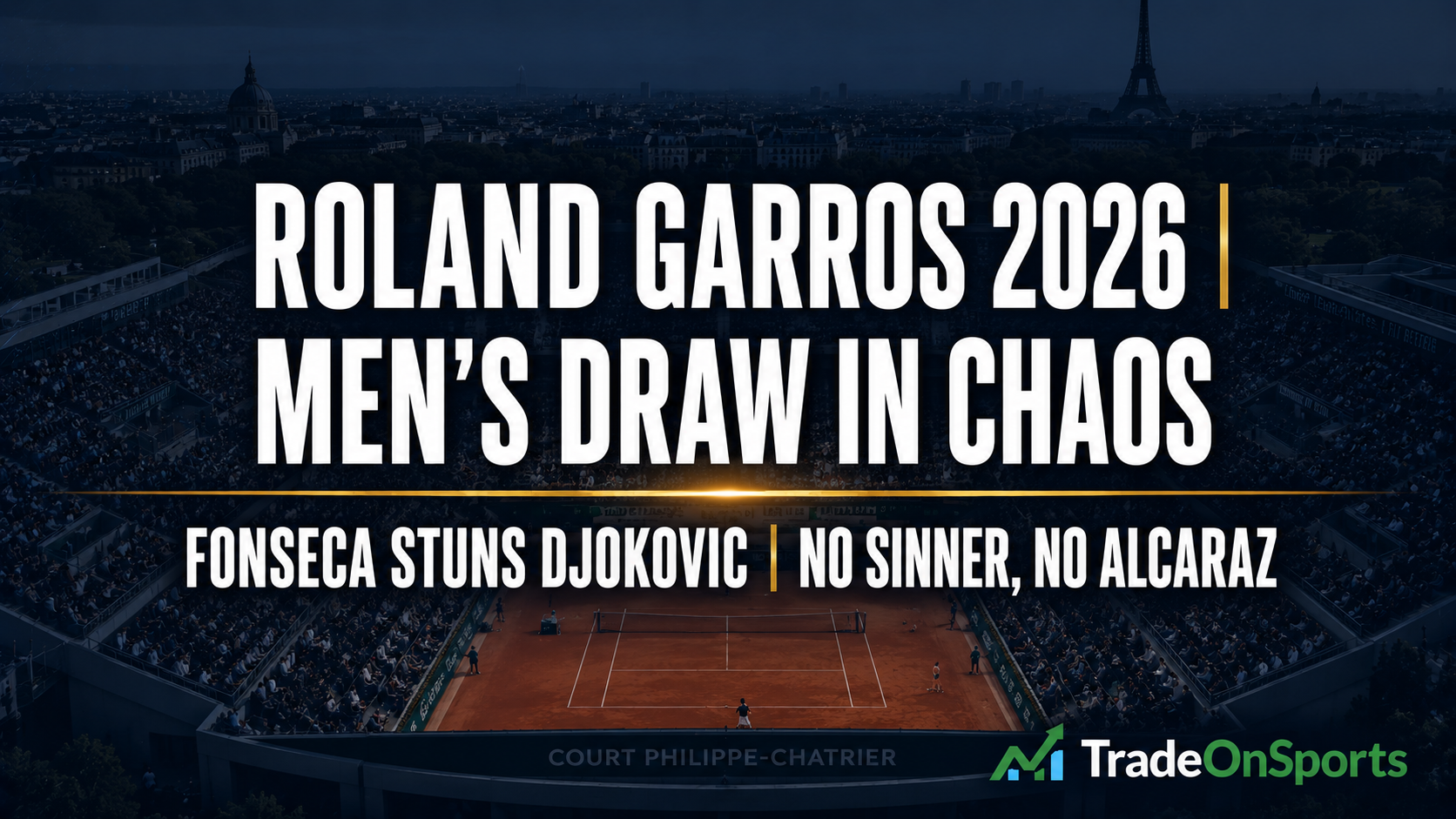
Roland Garros 2026 was supposed to follow a familiar script. Jannik Sinner, the world number one, would push deep into the second week. Novak Djokovic, a three-time champion here, would be lurking. Carlos Alcaraz, the defending champion, would make his move.
All three are out. The draw is genuinely open.
Sinner went first, losing in the second round on 28 May. Then Alcaraz. Then, on Friday 30 May, Djokovic fell to a 19-year-old from Brazil who trailed by two sets and came back to win.
João Fonseca beat Djokovic 4-6, 4-6, 6-3, 7-5, 7-5. The match lasted just under five hours. Fonseca dropped the first two sets to a player who knows exactly how to close out matches at Grand Slams. Then he changed everything.
What Fonseca actually did
Losing the first two sets to Djokovic at Roland Garros is not a position from which players typically escape. Djokovic’s ability to defend leads, to grind opponents into errors, to win ugly when he has to — all of it is built for that situation.
Fonseca did not care. He took the third set 6-3. He won the fourth 7-5. He closed the fifth 7-5. For the last three sets, he was the better player on the court.
At 19, he is now in the last sixteen of the French Open after beating one of the greatest clay-court players in the history of the sport. That is not a minor result.
The bigger picture for the men’s draw
The men’s draw now has no Sinner, no Djokovic, no Alcaraz in the quarter-final stage. Those three players have won 11 of the last 12 Grand Slam titles between them. Their collective absence at this stage of a major is unusual by any measure.
The men still standing in the fourth round include Fonseca, Matteo Berrettini, Alejandro Tabilo, Flavio Cobolli, Juan Manuel Cerundolo and Zachary Svajda. These are not names that regularly appear in Grand Slam quarter-final previews. Several have never reached this stage before.
The quarter-finals are on 2 and 3 June. The men’s semi-finals are on 5 June. The men’s final is 7 June. Whoever comes through this section of the draw will claim their first Grand Slam title without having beaten any of the three men who have dominated the sport.
That is not a knock on whoever wins. It is simply the statistical reality of a tournament that has turned out very differently to what was expected.
Gauff’s exit matters too
The women’s side had its own shock on the same day. Coco Gauff, the defending champion, lost her third-round match to Anastasia Potapova 4-6, 7-6, 6-4. Gauff had won this title in 2025 and came in as a genuine contender.
Potapova now moves into the fourth round against women who have been performing at a high level all tournament. Aryna Sabalenka, the world number one, beat Rybakina replacement Kasatkina 6-0, 7-5 in her third round and has been dominant throughout. Naomi Osaka, after a difficult stretch in her return to the tour, beat Jovic 7-6, 3-6, 6-4 and faces Sabalenka on Monday.
The women’s draw is considerably clearer. Sabalenka is the obvious favourite. The men’s draw is anyone’s guess.
What this means for traders
The pre-tournament market logic has collapsed on the men’s side. The three players who held most of the implied probability before the draw began are all gone. The remaining field is made up of players whose clay-court form at Grand Slams is largely untested at this level.
Fonseca has now won two five-set matches from two sets down in successive rounds. That suggests temperament and physical condition. Whether that translates into winning three more matches at Roland Garros is a different question.
The quarter-finals start Tuesday. The draw is open. The data from week one does not give clean answers for week two, which is precisely when this tournament becomes interesting to analyse




No comment