
Twenty-Eight Years. One Kick. One Ticket.
Scott McTominay’s overhead kick in the third minute of injury time at Hampden Park in November 2025 completed a 4-2 win over Denmark and sent Scotland to their first World Cup in 28 years. What followed inside that stadium, by all accounts, was something that had been building since the last time Scotland appeared in France in 1998.
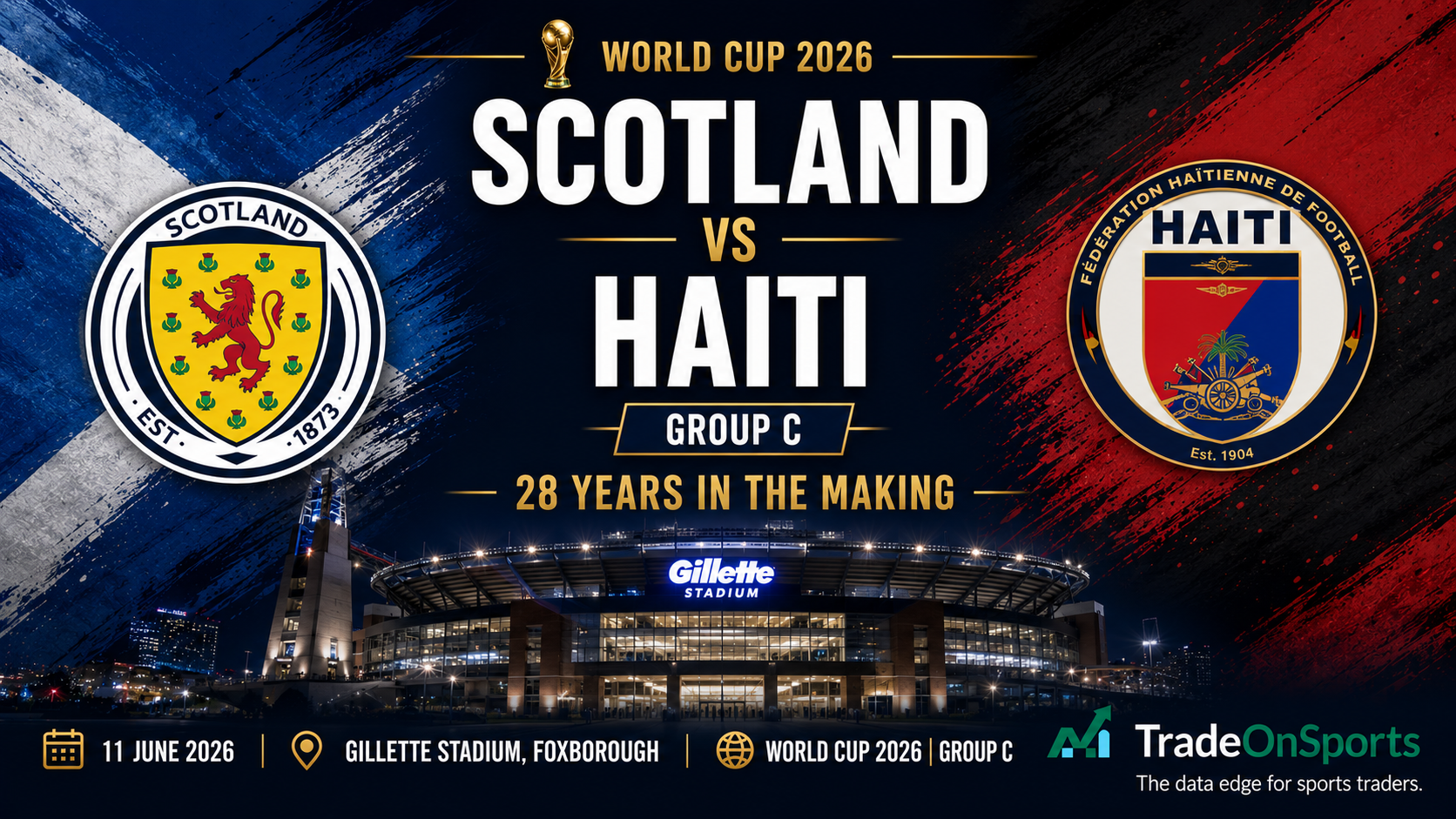
The Tartan Army will be in Massachusetts on June 13 for the opening Group C fixture against Haiti at Gillette Stadium. The match kicks off at 9pm ET, which means 2am in the morning for the support watching back home. There will be plenty awake.
The Group C Context
Group C is a proper group. Brazil are the favourites and are ranked 6th in the world. Morocco, who reached the World Cup semi-final four years ago, are 8th. Haiti are 83rd.
Scotland sit 43rd. They are the third seed in this group, which means their most achievable path to the knockout round runs through winning or drawing against Haiti, then looking for points against Morocco in their second match on June 19. Scotland face Brazil last, on June 24.
The structure matters because a win against Haiti on June 13 puts Scotland in a strong position regardless of what happens in the other group game that evening. At the 2026 World Cup, the top two teams in each group qualify automatically, with some third-placed teams also advancing. Scotland need to accumulate points, and Haiti are the team they are most likely to take them from.
There is also a historical echo that is hard to ignore. In 1998, Scotland’s group contained Brazil and Morocco. They lost to both and drew with Norway. At this World Cup, Scotland face Brazil and Morocco again. Haiti are in Norway’s old spot. Scotland will be desperate to avoid repeating the same three-game story.
Scotland: Organised, Experienced, Dangerous on Set Pieces
Steve Clarke’s Scotland do not look much like the teams of the 1990s. These are players who have spent the last several years competing in major tournaments. Euro 2020. Euro 2024. And now, the 2026 World Cup. Clarke, who has managed the national side since 2019, has built one of Europe’s most consistent qualifying outfits: organised, hard to beat, and capable of scoring goals in bunches when the opposition drops.
Their qualifying campaign for 2026 bore that out. Four wins, a draw and one defeat in UEFA Group C. Thirteen goals scored, seven conceded. The 4-2 win over Denmark to seal qualification was the kind of result that captures what Clarke’s Scotland are about: aggressive from the front, organised at the back, and with match-winners in the squad.
Pre-tournament friendlies gave a mixed picture. Comfortable wins over Curacao (4-1) and Bolivia (4-0) showed their firepower; defeats to Japan (0-1) and Ivory Coast (0-1) in friendly matches reminded Clarke there are levels above this squad. But friendly defeats to Japan and Ivory Coast are not embarrassments. They are preparation tests against quality opposition, and Scotland conceded just twice in those two matches, suggesting the defensive shape held even in defeat.
Their recent form across five matches: three wins, two losses, twelve goals scored, five conceded. The platform is there.
Haiti: Not Here to Make Up the Numbers
It would be easy to dismiss Haiti. The data says they are the weakest team in Group C on paper. Their 83rd-place FIFA ranking is 40 places below Scotland’s. They have not played at a World Cup since 1974.
But they topped their CONCACAF qualifying group to get here. They have a manager, Sébastien Migné, who has experience on the African continent with Kenya and Ethiopia. They have a captain, goalkeeper Johny Placide, who has seen everything across his 38 years. And they have players who can cause problems.
Wilson Isidor, the Sunderland striker who switched international allegiance from France to Haiti and made his debut for Les Grenadiers in March 2026, adds a physical and technical threat that did not exist in their qualifying campaign. Jean-Ricner Bellegarde, the Wolverhampton Wanderers midfielder, brings Premier League durability and pressing intensity to their midfield. And Duckens Nazon, Haiti’s all-time record scorer with 44 goals in 74 caps, knows where the net is.
Haiti’s recent form has been mixed. A 4-0 win over New Zealand and a draw with Iceland suggest they can compete. A 1-2 loss to Peru and a 0-1 defeat to Tunisia indicate they can be got at. Scotland, if they set up correctly, have enough to win this match. But it will not be comfortable simply by virtue of the ranking gap.
Key Players
Scotland
- Andy Robertson (Liverpool): The captain and the heartbeat. At 92 caps, he is the most experienced player in the squad. His delivery from left-back and his energy over 90 minutes set the tempo for everything else. He will have to manage Bellegarde’s pressing runs on his side.
- Scott McTominay (Napoli): The man who booked Scotland’s ticket to this tournament. McTominay has developed from a steady Manchester United journeyman into a proper Serie A midfielder under Napoli. His late goals, his physicality and his ability to carry the ball through congestion are central to how Scotland play.
- John McGinn (Aston Villa): Eighty-five caps and still the second man Scotland look to when the first option closes down. He reads the game quickly, covers enormous ground and scores goals that midfielders should not score. Haiti will need to stop him early.
Haiti
- Wilson Isidor (Sunderland): The most interesting player in the Haiti squad. French-born, technically sharp, with Championship pace. He will look to run in behind Scotland’s centre-backs and could be the one to catch Clarke’s side off-guard.
- Jean-Ricner Bellegarde (Wolverhampton Wanderers): Relentless in the press. He wins the ball and moves it quickly. Scotland’s midfield will need to be sharp on their second balls whenever Bellegarde is close.
- Duckens Nazon: Forty-four goals for his country. He has seen defences in this region, and he knows how to find space in tight areas. Scotland’s back line cannot afford to give him anything cheap.
Tactical Notes
Steve Clarke is likely to set up in a 3-4-3 or 4-3-3. Against Haiti, the temptation will be to take the game to them from the off. Robertson and the right-back, likely Aaron Hickey or Nathan Patterson, will be expected to push forward and create overloads. The challenge will be not to over-commit and leave space in behind for Isidor.
Haiti, under Migné, tend to sit mid-block and absorb pressure before transitioning quickly. If Scotland slow the ball and probe without penetration, Haiti will be content to hold the shape and wait for a set-piece situation or a turnover. The key for Scotland is to move the ball quickly and take shots early, before Haiti can settle.
Set pieces are likely to be a source of goals in this match. Scotland score them consistently, and Haiti’s defensive organisation at dead-ball situations against a side of Scotland’s physicality has not been fully tested at this level.
The Outlook
Scotland need to win this match. Not for the aesthetics, not for the occasion, but for the mathematics of a group that contains two top-ten teams in Brazil and Morocco. Points against Haiti are essential.
They should win. Their squad is deeper, better prepared for international football at this level, and playing with the momentum of three consecutive major tournament appearances under Clarke. But Haiti are not here to lose gracefully. Isidor and Bellegarde have real quality, and Nazon has the goals record to back it up.
If Scotland win, the story of this group changes. If they draw, the pressure builds before Morocco. If they lose, well: the echoes of 1998 will be deafening.
The Tartan Army will find out at 9pm ET on Saturday night. Most of them will be watching at 2am.



No comment