
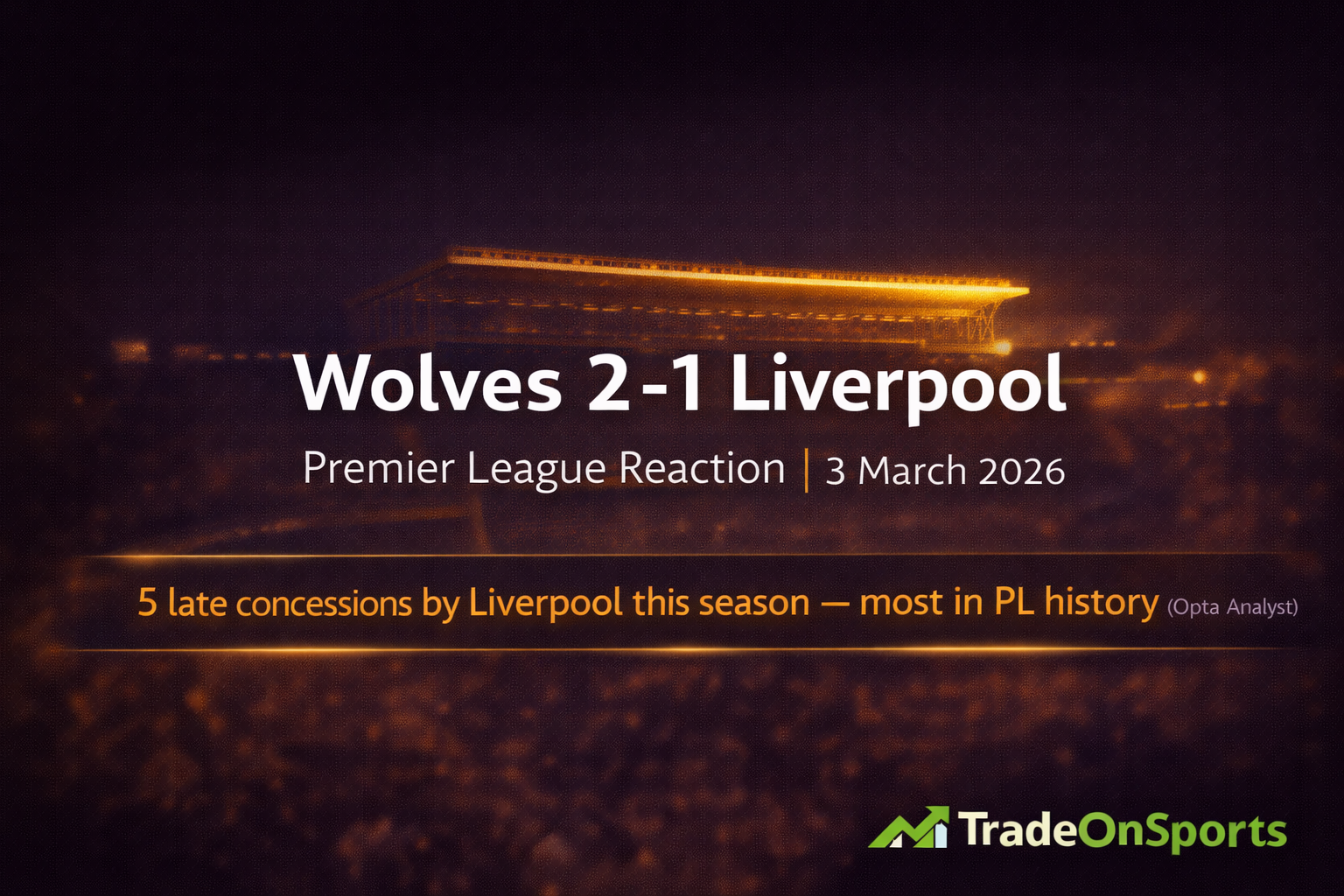
It was the kind of result that stops you mid-scroll. Bottom club, Molineux, a deflected winner four minutes into added time. Wolverhampton Wanderers 2-1 Liverpool. Read it again.
Tuesday night at Molineux produced one of the Premier League season’s great shock results. Wolves, rock bottom of the table, one win all season before their recent upturn, beat the reigning champions for the second time in quick succession to make it back-to-back victories for the first time since April 2024. Liverpool, who came into the night fifth in the table with three straight wins behind them, left without a point and with their Champions League ambitions looking significantly murkier than they did at kick-off.
How It Happened
Rodrigo Gomes struck in the 78th minute to open the scoring, capitalising on a Liverpool defensive lapse that will be watched back on video loops for some time. That prompted Mohamed Salah to respond, the Egyptian’s goal in the 83rd minute his first in 10 Premier League matches spanning 122 days, a remarkable drought for a player of his calibre. Liverpool looked on course to escape with a point.
They did not.
In the fourth minute of added time, André, who had not scored all season, produced a strike from outside the box that deflected off Joe Gomez and looped past Alisson. The goalkeeper was helpless. Molineux erupted.
The Statistics That Tell the Story
Opta’s post-match data confirmed a fact that deserves to be absorbed slowly: this was the fifth time this season that Liverpool conceded a winning goal in the 90th minute or later. That is the most by any team in a single Premier League campaign. Ever.
Five times. The most in history.
For a team managed by Arne Slot, a coach with a clear reputation for structured, controlled football, those late collapses represent a systemic vulnerability that rivals and the data have both now identified. Liverpool dominate possession. They create chances. But when the game is in the balance and bodies are committed, the margins have repeatedly cost them.
André’s winner carried an additional footnote: it was the first time in Premier League history that a team in the relegation zone scored a stoppage-time winner against the reigning champions. History, made in old gold and black.
What This Means for the Table
Liverpool stay fifth. A victory would have moved them third. Instead, the gap to the teams immediately above them remains, and the question of whether Slot’s side can sustain a top-four push through the remainder of the campaign now has renewed urgency. Their Champions League journey continues, but domestic form, already inconsistent, took another dent that is difficult to ignore.
For Wolves, the picture is more complicated. Back-to-back wins is a genuine momentum shift, and the quality of the scalp, Liverpool, at Molineux, under the lights, will lift confidence through the squad. But they remain bottom of the table. The fight against relegation continues. What Tuesday’s result confirmed is that this team, in this ground, with a crowd behind them, can produce performances that test anyone in the division.
The data that matters for Wolves’ survival is not Tuesday night’s scoreline. It is the broader points total and the gap to safety. But football is played by human beings who respond to moments. Tuesday night was a moment.
The Angle to Watch
The story running through Liverpool’s season — the stoppage-time concessions, the late drops — is now a pattern, not an anomaly. Five times. If you had offered Slot’s squad a clean sheet in the final minute of any one of those five matches, they would be in a considerably more commanding position in the table. Instead, they are fifth, looking upward at teams between them and Champions League football.
Wolves have their own survival arithmetic to solve. But for one night at Molineux, none of that mattered.
Information sourced from Sky Sports, Opta Analyst, NBC Sports, and ESPN. Data correct at time of writing.






No comment