
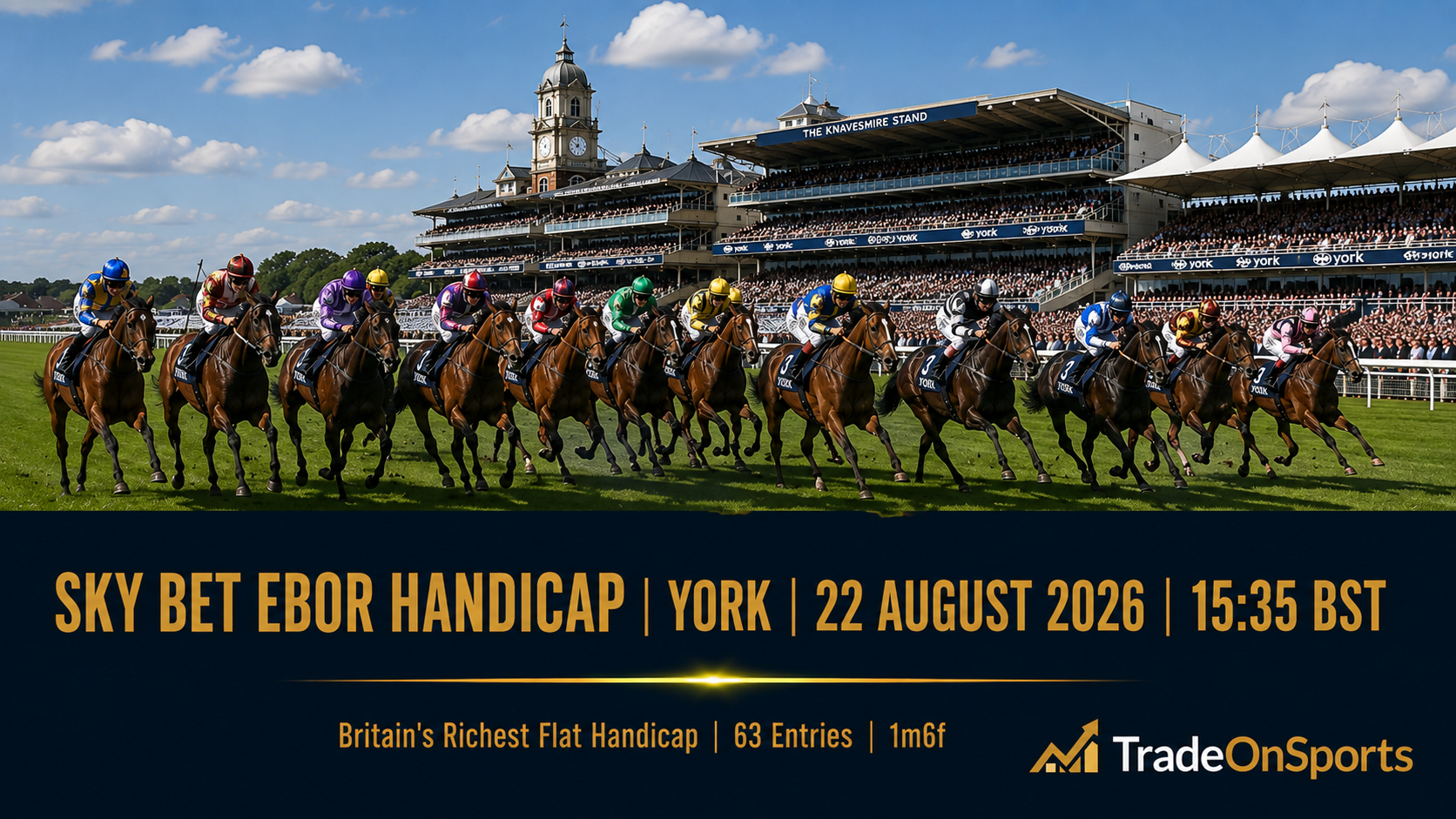
Sixty-three horses entered. One prize. One of the most open betting races in the British flat calendar.
The Sky Bet Ebor Handicap runs at York’s Knavesmire on Saturday 22 August at 15:35 BST, over 1 mile 6 furlongs, and it is Britain’s richest flat handicap. That title is not marketing. The Ebor is a heritage race that attracts the best staying handicappers from Britain and Ireland each August, and the field size, 63 entries for this year’s running, reflects exactly how much the industry values it.
Heritage handicaps are a specific category of British racing: they carry higher ratings ceilings and attract horses that would otherwise be competing at Group level. The Ebor sits at the top of that tree. Winning it means something lasting: the race’s roll of honour is full of horses who went on to compete and win at Group level in the weeks that followed.
Why the Field Size Matters
Sixty-three entries is a large number even by Ebor standards. That volume tells you several things.
First, it tells you that trainers across Britain and Ireland believe they have a viable contender. When a race attracts 63 entries, it is not because 63 horses accidentally qualified, it is because 63 sets of connections looked at the conditions, the prize money, and the likely competition, and decided the risk-reward calculation made sense.
Second, it tells you the race will be competitively weighted. Handicappers assign ratings to ensure horses with different ability levels compete on fair terms. With 63 entries, the weights are likely to be spread across a wide range of official ratings, meaning the race will not be dominated by a single heavyweight. In an ideal handicap, every horse should theoretically have the same chance.
In practice, some profiles suit the Ebor better than others. Horses who have won at a slightly shorter distance and are stepping up in trip often thrive. Horses proven on good to firm ground at York have a specific advantage. And horses trained in yards that win handicaps — not just Group races, but handicaps specifically, tend to be placed with thought.
Kizlyar: The O’Brien Call
Kizlyar, trained by Joseph O’Brien, arrives with the strongest form profile of the three named market movers. He won the 2026 Ascot Stakes, a competitive staying handicap at Royal Ascot, which is about as solid a preparation for the Ebor as you will find.
The Ascot Stakes runs over 2 miles at Royal Ascot in June, and horses who win it often come back to form over shorter trips in August as the season progresses. Kizlyar stepping back to 1m6f at York is not a concern: the Ascot Stakes form is proven Group-level staying form, and the switch to Knavesmire conditions adds interest rather than doubt.
Joseph O’Brien training the Ebor winner would not be a surprise. His yard operates at the highest level in Ireland and Britain, and he has a record of placing horses in the right races at the right time. Kizlyar at 10/1 ante-post (Paddy Power, at time of writing) reflects market respect for both the horse and the trainer.
Tarriance: The Second String
Tarriance sits alongside Kizlyar at 10/1 in the ante-post market (bet365, at time of writing). Less information is available at this stage about her preparation, but a 10/1 ante-post price in an Ebor-quality field with 63 entries represents genuine market opinion. Something in her form or profile has attracted bookmaker concern at that level.
The ante-post market in big handicaps is worth treating seriously. Bookmakers rarely make a horse 10/1 in a 63-runner field without a reason. The question is whether the reason holds up closer to race day, when jockey bookings and final declarations confirm the horse is taking its chance.
Klassleader: Course Form Counts
Klassleader brings something the other market movers may lack: proven form at York. He won the Jorvik Handicap, a Knavesmire event that gives him a track record specifically at this course. Course and distance form matters in big handicaps, where the conditions are often more variable than in Group races.
Trainers who enter Jorvik Handicap winners in the Ebor understand the course. Klassleader’s victory there is a data point, not a coincidence. He has handled the Knavesmire, handled a competitive handicap at York, and his connections believe he can step up in class.
At 11/1 ante-post, the market is saying he is a contender but not the outright pick. That gap in the market between 10/1 and 11/1 is marginal and should not be read as a meaningful difference in probability at this stage.
What Makes a Successful Ebor Profile
Across the race’s recent history, certain patterns repeat. Winners tend to come from horses that have run within the last three to four weeks and are in a clear upward curve of form. Horses who peaked in June and have been waiting for the Ebor often find the pace and distance catches them out.
Staying pedigree matters over 1m6f on fast ground. Horses with proven stamina at a mile and a half or beyond are preferred. York’s straight does not offer the same premium for a horse that stays at 2 miles as it does for one that truly excels over this distance.
The draw in large fields on the Knavesmire can be relevant. Wide draws in big fields sometimes get detached from the main pace. Watch the stalls positions when they are confirmed and note any horses in the outer double-digits who have proven they can race handily from a wide gate.
Our View
Kizlyar’s Ascot Stakes form is the most concrete piece of data available at this stage. An Ascot Stakes winner trained by Joseph O’Brien at 10/1 in the Ebor is a logical starting point for anyone working through the card. Klassleader’s York form is a secondary consideration that keeps him in the picture.
Tarriance at the same ante-post price as Kizlyar warrants a closer look when jockey declarations and final form are confirmed closer to Saturday.
With 63 entries and a race this competitive, there will be horses worth considering that are not yet visible in the ante-post market. Final declarations, which narrow the field significantly from 63 entries to the raceday runners, are the moment when the picture becomes clearer.
All prices are ante-post and subject to change. Jockey declarations are expected on Friday 22 August — check Racing Post for confirmed riding arrangements before the off.







No comment