

For the first time in ATP Masters 1000 history, all eight quarter-finalists at the Rogers Cup in Montreal were born in the 2000s.
That deserves a moment. The Masters 1000 format has run since 1990. Across 36 years of the series, the quarter-final draw has always contained at least one player born before the year 2000. This week in Montreal, that changed. The last member of the previous generation has been eliminated. Eight players remain, all aged 25 or younger.
The milestone in context
Ben Shelton (USA, world No. 10) is the highest-ranked player left in the draw. Jakub Mensik (CZE, world No. 18), Learner Tien (USA, world No. 20) and Arthur Fils (FRA, world No. 25) follow him in the rankings. Luciano Darderi, Brandon Nakashima, Daniel Merida Aguilar and the 20th seed complete the lineup.
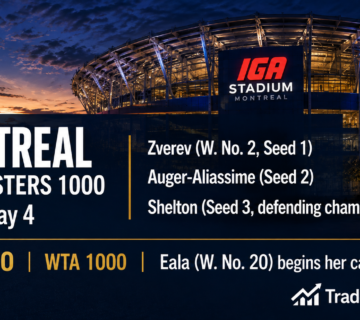
All eight won their way here without a free path. Alexander Zverev, among the pre-tournament favourites, was beaten earlier in the week. The draw opened as the week progressed, and what filled the space was not experience-management or defending records. It was young players who played better tennis than the players ahead of them in the draw.
The ATP Tour has been in visible generational transition for several years. Players like Carlos Alcaraz, Jannik Sinner and Holger Rune pushed into the top ten. But Masters 1000 quarter-final draws continued to carry names from the Federer-Nadal-Djokovic era on one side of the bracket. Not this week. Montreal 2026 is, so far, the clearest data point that the transition is complete.
The headline match: Mensik vs Shelton
Ben Shelton is the defending Rogers Cup champion, having won this title in 2025. He is the world No. 10 and the fifth seed at this event. His serve is among the fastest on the ATP tour. On fast hard courts like those in Montreal in August, Shelton’s combination of serve, pace and first-strike baseline play makes him one of the most difficult players to break down in three-set tennis.
He reached the quarter-final by beating Joao Fonseca 6-3, 7-6(3). The win was not comfortable — Fonseca took him to a tiebreak — but it confirmed that Shelton has the big-match composure that eluded him at the same stage earlier in his career.
Jakub Mensik is world No. 18 and seeded 13th at this event. He is 19 years old. He beat Botic van de Zandschulp 6-4, 7-5 in the round of sixteen — a clean, efficient win against an experienced opponent on hard courts. Mensik’s game is built on flat, driven groundstrokes and early ball-striking. He does not invite long baseline exchanges. He tries to end points in the first three or four shots.
Against Shelton’s serve, that is harder than it sounds. Shelton’s first serves regularly exceed 230 km/h. Mensik will need to read the ball early and redirect pace rather than generate his own. His return game, which has developed noticeably this season, is the one tool capable of neutralising Shelton’s biggest weapon.
Shelton’s challenge runs in the other direction. Mensik’s flat drives do not read easily. His forehand can compress the court from wide angles and force errors from players who position themselves centrally. Shelton prefers open-stance baseline play. Mensik can exploit the angles if he wins the first strike.
The surface favours short points. Hard courts in Montreal in August conditions play fast. Both players want to end rallies early. Whoever takes control of first-strike opportunities will likely take the match.
The rest of the draw
Learner Tien (world No. 20, seeded 12) meets unseeded Daniel Merida Aguilar. On the numbers, Tien should be the favourite. Merida Aguilar’s run to the quarter-finals without a seeding is the story here. Unseeded players do not reach the last eight at Masters 1000 events by accident.
Arthur Fils (world No. 25, seeded 18) is, for many observers, the most complete player in this half of the draw. The Frenchman plays with pace and variety on hard courts and has the physical game to sustain long matches. He faces the 20th seed.
Luciano Darderi (seeded 19) against Brandon Nakashima (seeded 28) is the fourth match. Both players handle hard courts well. Nakashima is one of the better returners among young Americans on the tour. Darderi has been consistent in 2026. This is an open match.
The US Open window
The Rogers Cup is the last ATP Masters 1000 event before the US Open. Players who arrive in New York with form and confidence from Montreal tend to carry it. Shelton, as defending champion, understands this as well as anyone in the draw. A second Montreal title before Flushing Meadows would put him in a strong position heading into a Slam he has consistently performed at.
For Mensik, Tien, Fils and the others, a quarter-final win in Montreal would confirm that their results this week were not a function of a soft draw. It would mean they beat a top-ten or top-twenty player on the way to the last four at a Masters 1000. That has a value beyond the points.
What Tuesday means
The eight players in this quarter-final lineup were still in primary school when the last of the previous generation was winning Grand Slams. They grew up watching the dominance of older champions, absorbing the standard of shot-making, movement and consistency that a generation of top-ten players had normalised. They are not pale imitations of what came before. The numbers say they are among the twenty best players on the tour right now.
Montreal 2026 has confirmed it on paper. Tuesday’s matches will confirm it in practice.



No comment