

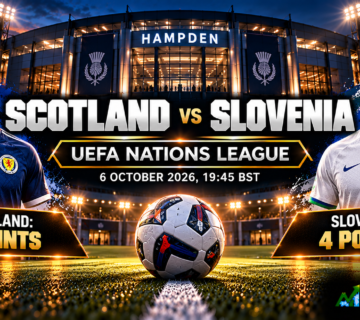
Scotland vs Slovenia finished 1-2 at Hampden Park on Tuesday, after Ryan Christie’s opening goal was overturned by Aljosa Matko and Danijel Sturm. Scotland had a lead to protect. Instead, Slovenia left Glasgow with the points and a firmer hold on second place in Nations League Group B1.
The completed result leaves Scotland third with four points from four matches, while Slovenia have seven. Switzerland lead on 12 and North Macedonia remain without a point. With two games left, the immediate problem is visible in the table: Scotland now have ground to recover rather than a position to defend.
A lead that did not settle the match
Christie’s goal gave Scotland the first advantage. Sky Sports’ report describes him finishing after Jack Hendry’s header came back off the post.
The sequence matters because it explains how the opener arrived without asking the goal to stand for more than it did. Scotland took a chance from a loose ball in the area. They did not, by scoring, remove Slovenia’s ability to change the game.
Matko later equalised. He also had an effort disallowed for offside before combining with Sturm for the winning goal. The visitors’ response supplied the decisive part of the match account: the team that trailed found the goals that changed the result.
We have kept the Slovenian goals’ minute labels out of this report because the source’s score panel and running timeline differ slightly. Their order and scoring identities are clear. Adding a disputed minute would offer no analytical benefit and introduce an avoidable inconsistency.
The table changes the meaning of the defeat
At full time, Slovenia were second and Scotland third. The updated table shows a three-point difference between them.
That gives the result more weight than an isolated home defeat. It was a meeting between sides pursuing a better group position, and the points went to the team immediately above Scotland.
The difference is still a current gap, rather than a final verdict. Two group matches remain. Scotland’s task is to improve their position through those games, while Slovenia’s immediate aim is to protect second place. Neither objective should be presented as an outcome already secured.
Switzerland’s 12 points provide further context. We should not describe Scotland as matching the group leaders when the table shows otherwise. The useful comparison after this match is with the side that has just moved three points ahead of them.
For Slovenia, the victory turns a difficult first half into a strong result. They leave Hampden with seven points, and the win directly improves their position relative to Scotland. That is the measurable gain.
Scotland’s window needs a measured reading
Sky Sports reports that Scotland won one of the four games in this international window. Tuesday’s defeat closes that sequence with disappointment rather than the home win they wanted.
There is no need to turn the total into a sweeping judgement on every player or the whole coaching project. Four matches provide evidence about this window. They do not answer every question about the team’s future.
What they do establish is the current starting point. Scotland have four points, sit third and will return for the remaining group games against North Macedonia and Switzerland. That is the task a future preview must assess.
A useful follow-up should examine what happened when the lead was lost, using verified match data where it adds detail. It should avoid making a possession figure or a chance-quality estimate appear from nowhere. The present account is built around the scoring sequence and confirmed table.
Why the disallowed effort stays separate
Matko’s offside effort belongs in the match story, but it is not an additional goal.
That distinction is basic to accurate reaction writing. A disallowed finish can show the pressure within a game. It cannot change the final score, a player’s official goal total or the points awarded.
The same principle applies to Scotland’s appeals in the closing stages. A request for a penalty is not evidence that a penalty should have been given. Without making an unsupported refereeing judgement, we can report the result and the confirmed goals that decided it.
For traders reviewing the match, event classification matters. A goal, a disallowed goal and an appeal are different entries. Treating them as interchangeable can distort the story even when the headline score is correct.
What comes next
Scotland’s remaining fixtures offer the opportunity to change third place, but the next results are not known. The loss to Slovenia makes those games more demanding in terms of the points Scotland need to recover.
Slovenia have the advantage earned at Hampden. Their comeback does not guarantee the final group order, but it does mean they will begin the closing rounds ahead of Scotland.
Our conclusion stays with that evidence. Christie gave Scotland the lead; Matko and Sturm overturned it; Slovenia now have seven points to Scotland’s four. A home advantage and a half-time lead were both real. Neither survived as points in the final table.


No comment