
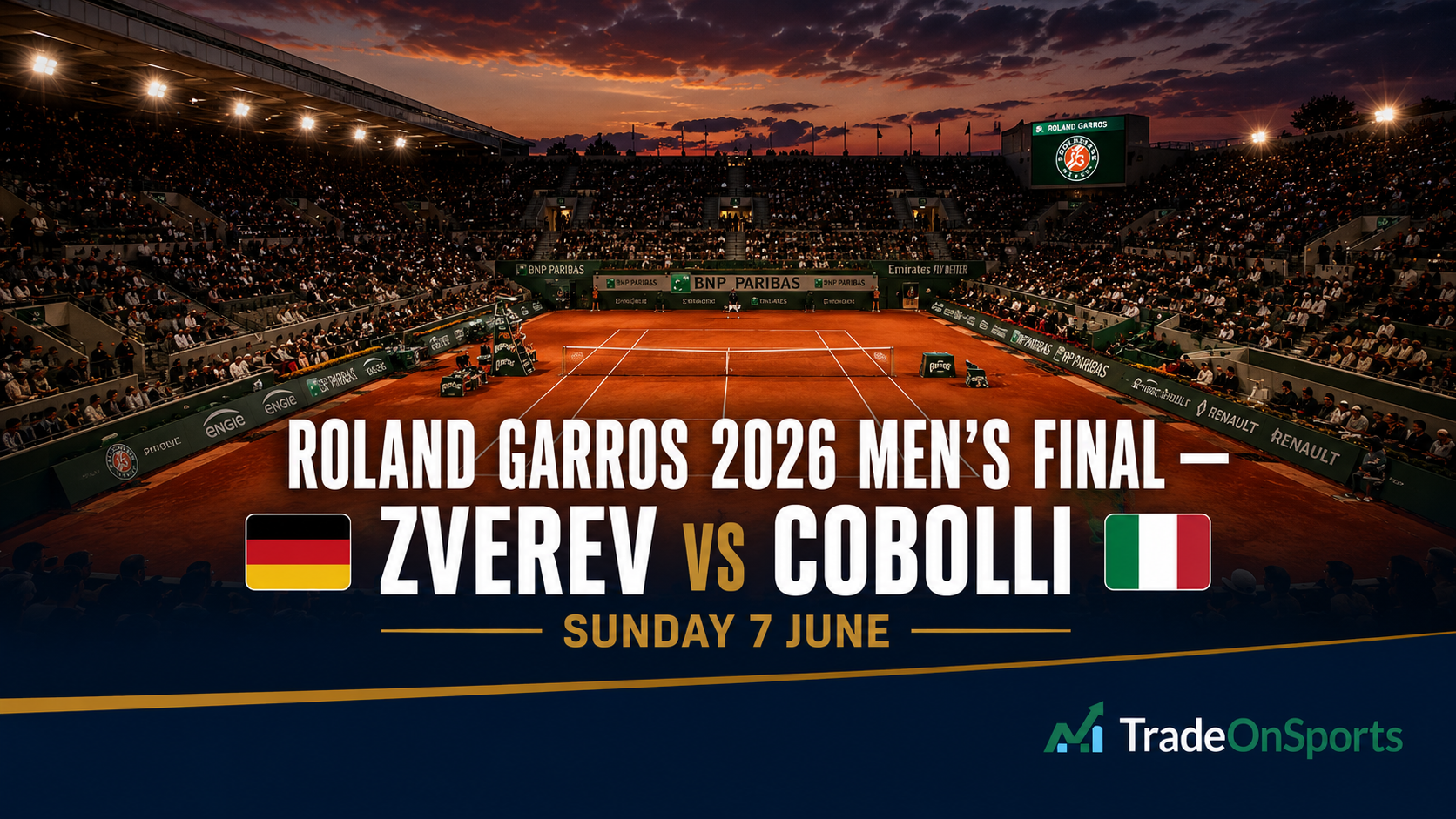
Alexander Zverev has been here before. Three times, in fact. Each time, he left without the title.
On Sunday at Court Philippe-Chatrier, the 29-year-old German has a fourth chance. His opponent is Flavio Cobolli, 24, from Italy. Cobolli has not been here before. This is his first Grand Slam final. It may be the biggest match of his life.
One of them wins their first major on Sunday. The Roland Garros 2026 final is set, and it is a good one.
How They Got Here
Alexander Zverev is the No. 2 seed and has moved through the draw with the efficiency of a player who knows what he is doing on clay in Paris. He dropped just two sets across six matches before Friday’s semi-final. Against Jakub Mensik on Friday, he took the first set 7-5, dominated the second 6-2, allowed a wobble in the third (3-6), then closed it out cleanly in the fourth, 6-3. Mensik is not an easy opponent on clay. Zverev did not make it look difficult.
His run included wins over two seeded players and not a single five-set match. He arrives in Sunday’s final fresh, confident and carrying the weight of three previous final defeats.
Flavio Cobolli is the No. 10 seed and has matched Zverev in efficiency: two sets dropped across six matches. His headline result was the quarter-final, where he knocked out fourth seed Felix Auger-Aliassime 4-6, 6-4, 6-4, 6-4. That win confirmed Cobolli as a genuine contender. The semi-final against Matteo Arnaldi was won by walkover after Arnaldi withdrew with a virus, a bittersweet path to a first Grand Slam final, but a path nonetheless.
Cobolli’s data through this tournament is strong. He is only the third Italian man in the Open Era to reach the Roland Garros final, after Adriano Panatta in 1976 and Jannik Sinner in 2025. Italy will have a man in the final for the second consecutive year.
Head-to-Head
Zverev leads the head-to-head 3-1 overall and 2-0 on clay. The clay record matters most here.
But the clay record contains a contradiction. At the 2026 Munich Open on clay earlier this year, Cobolli beat Zverev 6-3, 6-3 — a convincing straight-sets win. At the 2026 Madrid Open on clay, also earlier this year, Zverev won the rematch 6-1, 6-4. In their two most recent clay meetings in 2026, they split one apiece.
The Madrid result has more weight for Sunday’s conditions. The Madrid Open clay is red clay, similar to Roland Garros in speed and bounce. Zverev won that encounter with a clean 6-1, 6-4 — 12 aces to Cobolli’s one, according to ATP Tour data. That is dominance of a specific kind. Zverev’s serve on clay in Madrid was untouchable.
At Roland Garros specifically, Cobolli holds a stronger record: 8-3 across four main-draw appearances. Zverev’s clay overall is excellent, but the Philippe Chatrier surface in late-tournament conditions is specific. Cobolli has shown he can perform here.
The Numbers That Matter
Zverev: 29 years old, ranked No. 2 in the world, three previous GS finals (all losses). Lost the 2024 Roland Garros final — which means he has already stood on this court in a final and lost. Sunday is his chance to rewrite that.
Cobolli: 24 years old, ranked No. 10, first GS final. Thirty-seven wins in his last 50 matches per ATP Tour data. An Italian player whose game is built around clay-court aggression: heavy topspin forehand, good movement, willing to extend rallies.
Neither player has won a Grand Slam title. That shared pressure is the most human element of Sunday’s match.
Surface, Conditions, Tactics
Court Philippe-Chatrier plays slow in late June. The ball sits up on heavy clay. Topspin counts. Depth of return counts. Serving big helps only if you can convert on second shots, a pure serve domination is harder to sustain here than on grass.
Zverev’s key weapon on clay is his forehand combined with a powerful serve. In Madrid, that combination worked perfectly. In Munich, Cobolli neutralised it with excellent return positioning and early aggression on the Zverev second serve. The question Sunday is whether Cobolli can replicate Munich or whether Zverev has made adjustments since.
Cobolli’s approach: heavy topspin to Zverev’s backhand, attack the net when the opportunity presents itself, do not get drawn into extended backhand-to-backhand exchanges where Zverev’s height and reach become advantages.
Zverev’s approach: use the serve to dictate, attack the Cobolli backhand, keep rallies at medium pace where his height advantage in the strike zone becomes relevant.
Our Data Read
Zverev is the clear favourite, odds at time of writing suggest roughly 75-80% win probability across most tennis analytics models. He has the experience of three major finals, the better recent clay record at this specific tournament, and the Madrid benchmark to draw from.
Cobolli is a live underdog. His Munich result against this opponent on this surface type, his form through this tournament (only two sets dropped), and his history at Roland Garros (8-3) all point to a player who will make this competitive.
A straight-sets Zverev win is the most likely outcome by probability. A four-set win for Zverev is the most defensible prediction. A Cobolli win would be one of the bigger upsets seen in a Roland Garros final for some years.
For value traders: if you have a position or an interest in the outcome, the current pricing reflects a straightforward Zverev win. Any Cobolli outright bet carries significant uncertainty. The H2H does not help him. The Munich result does.
The Bigger Picture
Zverev at 29 with four GS final appearances and no title is one of tennis’s long-running stories. He is a brilliant player. He has everything it takes except the result. Sunday offers another answer.
Cobolli at 24 in his first final is a story of a different kind. He is young enough that if Sunday does not go his way, there will be more chances. But first Grand Slam finals at Roland Garros on clay are not offered twice a year. He will want to take this one.
The final is at 14:00 BST on Sunday 7 June, Court Philippe-Chatrier, Paris.




No comment